About this worksheet
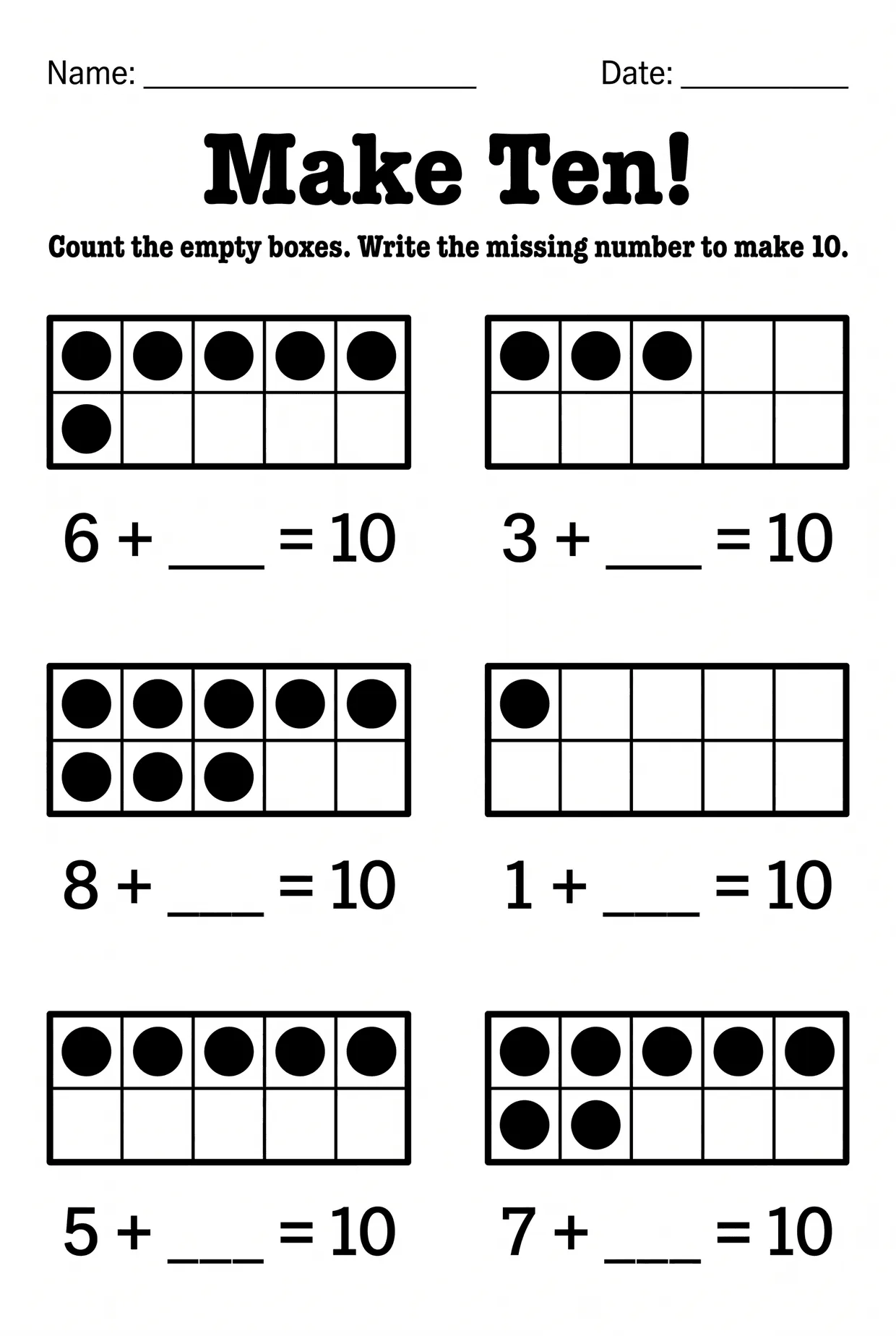
Six ten-frames, each partly filled with solid dots, and under every one an addition sentence with a gap in the middle: 6 + ___ = 10, then 3, 8, 1, 5 and 7. The empty squares are the answer, sitting right there to be counted, so a child who cannot yet recall that 6 and 4 make 10 can still get there by looking.
Making ten is the quiet workhorse of first grade arithmetic. It is what lets a child break 8 + 5 into 8 + 2 + 3, and it underpins the three-addend sheet in this set. The missing number sits in the middle of the sentence rather than after the equals sign, which is worth a mention, since some children read every blank as “the answer goes here” and need to see that the unknown can live anywhere.
What students will practice
- Find the number that completes ten
- Read a quantity from a ten-frame
- Solve an addition sentence with a missing addend
Details
- Grade level
- Grade 1
- Subject
- Math · Addition
- Standard
- CCSS 1.OA.6
- Pages
- 1
- Format
- PDF · US Letter and A4 included
- License
- Free for classroom use · Attribution appreciated
- Last updated
- August 23, 2026