About this worksheet
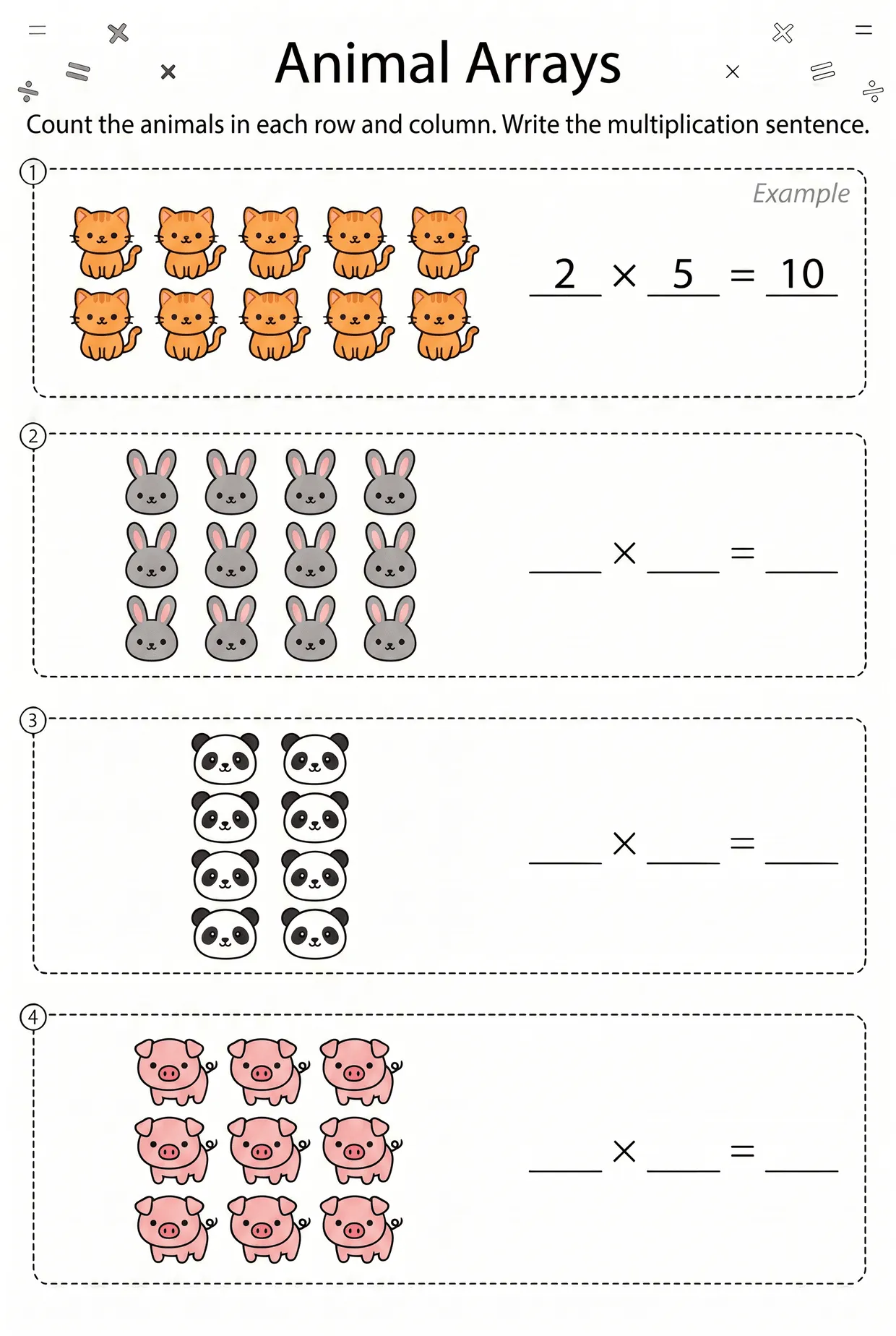
Under the heading “Animal Arrays,” four numbered panels each hold a neat grid of animals with blank spaces for the multiplication sentence at the right. The first panel is worked as an example, 2 rows of 5 kittens making 10, so the child completes three: 3 rows of 4 bunnies, 4 rows of 2 pandas, and 3 rows of 3 pigs. The panda array is the one tall, narrow arrangement, which is a useful nudge that rows and columns can trade places.
Sit with your child for the example, saying it out loud as “2 rows of 5 is 10,” then let them work the rest alone. Arrays are how second graders usually meet multiplication, well before any facts are memorized, and counting a picture keeps the idea tied to something they can see.
What students will practice
- Count the rows and columns in an array
- Write a multiplication sentence to match a picture
- Connect equal rows to a total
Details
- Grade level
- Grade 2
- Subject
- Math · Multiplication
- Pages
- 1
- Format
- PDF · US Letter and A4 included
- License
- Free for classroom use · Attribution appreciated
- Last updated
- July 20, 2026