About this worksheet
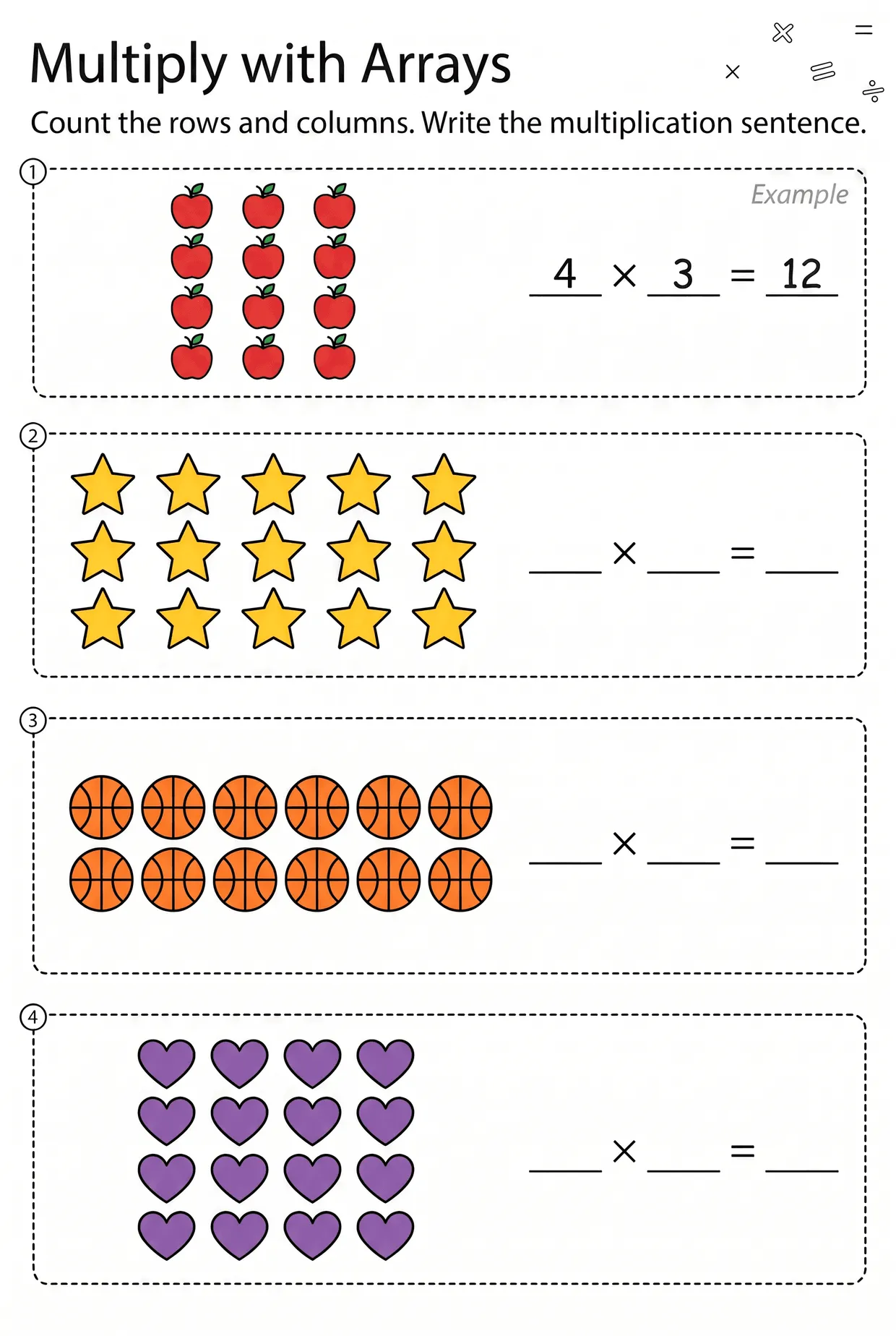
Everyday objects stand in for animals here. The example panel shows 4 rows of 3 red apples making 12, then the child works the remaining three: 3 rows of 5 yellow stars, 2 rows of 6 basketballs, and 4 rows of 4 purple hearts. Two of the four arrays land on 12 by different routes, which is worth pointing out once the page is done.
Use it as a second or third array sheet, once the idea of rows and columns has settled. Working with plain shapes and objects helps a child see that the arrangement is doing the mathematical work, and it prepares them for the neutral dot arrays they will meet later.
What students will practice
- Count the rows and columns in an array
- Write the multiplication sentence for a picture
- Compare arrays that share the same total
Details
- Grade level
- Grade 2
- Subject
- Math · Multiplication
- Pages
- 1
- Format
- PDF · US Letter and A4 included
- License
- Free for classroom use · Attribution appreciated
- Last updated
- July 20, 2026