About this worksheet
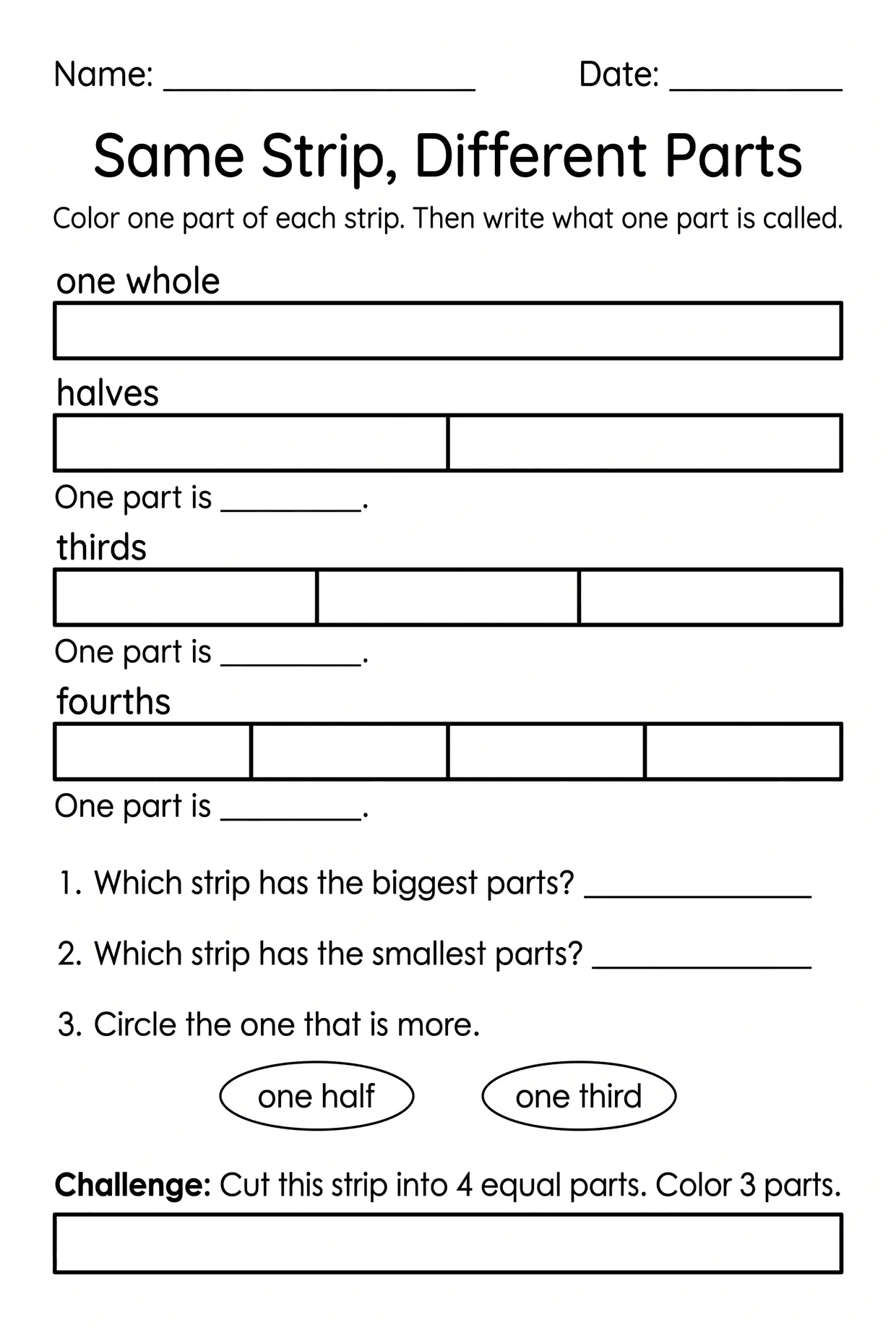
Four strips of identical length stack down the page, cut into one, two, three and four equal parts. The child colors one part of each and writes what that part is called, then answers which strip has the biggest parts and which has the smallest. A challenge strip at the bottom asks for four equal parts with three of them colored.
Because every strip starts the same length, the counterintuitive fact lands on its own: the strip with the most pieces has the smallest ones. That is the idea children carry the wrong way round for years, and seeing one third sit visibly longer than one fourth is far more convincing than being told.
What students will practice
- Compare halves, thirds and fourths of the same whole
- Name one part of each strip
- See that more parts means smaller parts
Details
- Grade level
- Grade 2
- Subject
- Math · Fractions
- Standard
- CCSS 2.G.A.3
- Pages
- 1
- Format
- PDF · US Letter and A4 included
- License
- Free for classroom use · Attribution appreciated
- Last updated
- September 3, 2026