About this worksheet
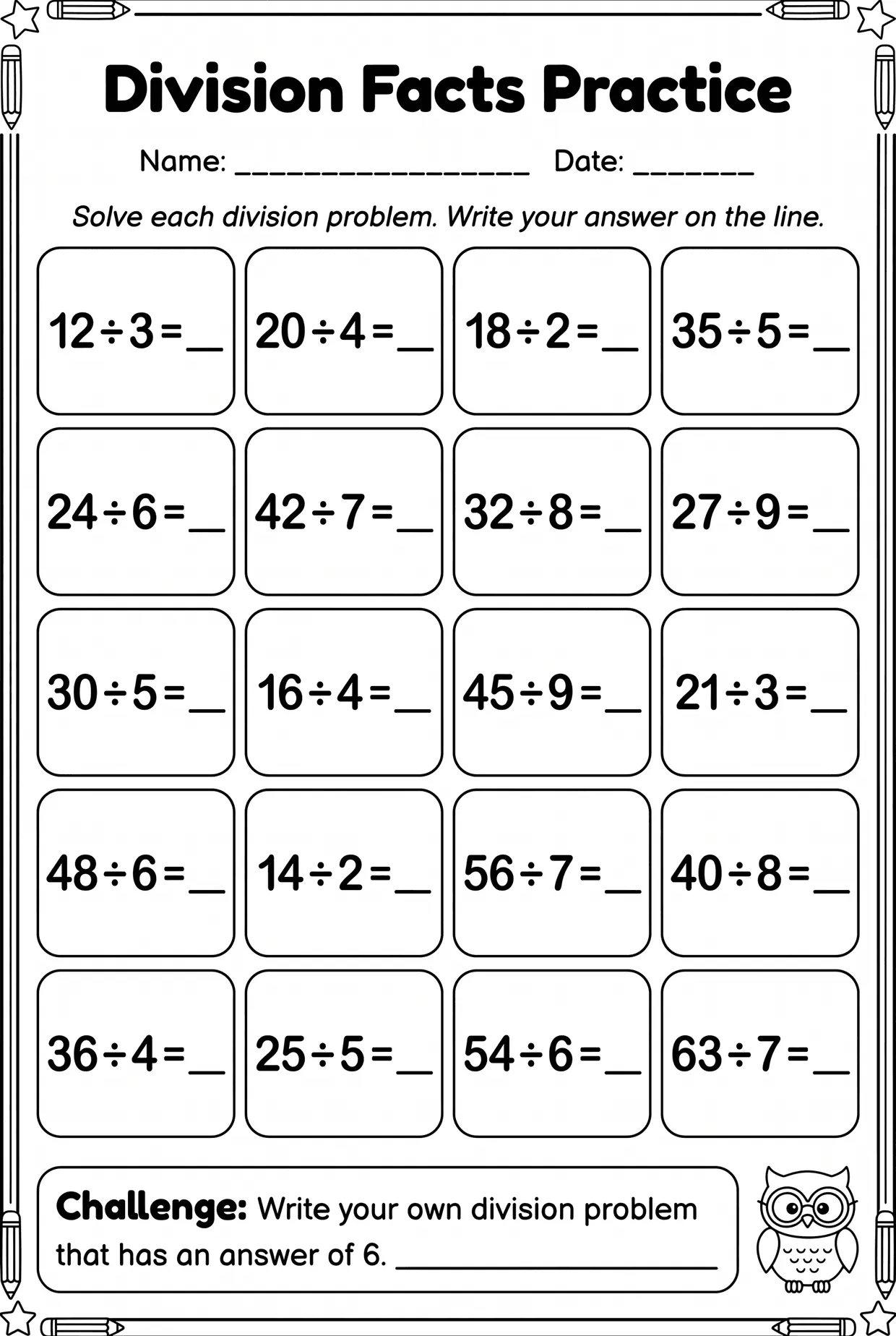
Twenty division problems sit in a grid of four across and five down, each in its own rounded box with a line for the answer. Divisors run from 2 to 9 and no problem leaves a remainder, so a child who knows the related times table can work straight through without getting stuck on something the lesson has not covered yet.
The order is deliberately shuffled rather than grouped by divisor, which keeps a child reading each problem instead of settling into one table and coasting. At the bottom, a challenge box turns the work around and asks for a division problem of their own that answers to 6, which is a quick way to see whether the connection to multiplication has actually landed.
What students will practice
- Divide within 100 with divisors 2 through 9
- Recall division facts from the matching times table
- Write a division problem for a given answer
Details
- Grade level
- Grade 3
- Subject
- Math · Division
- Pages
- 1
- Format
- PDF · US Letter and A4 included
- License
- Free for classroom use · Attribution appreciated
- Last updated
- August 28, 2026