About this worksheet
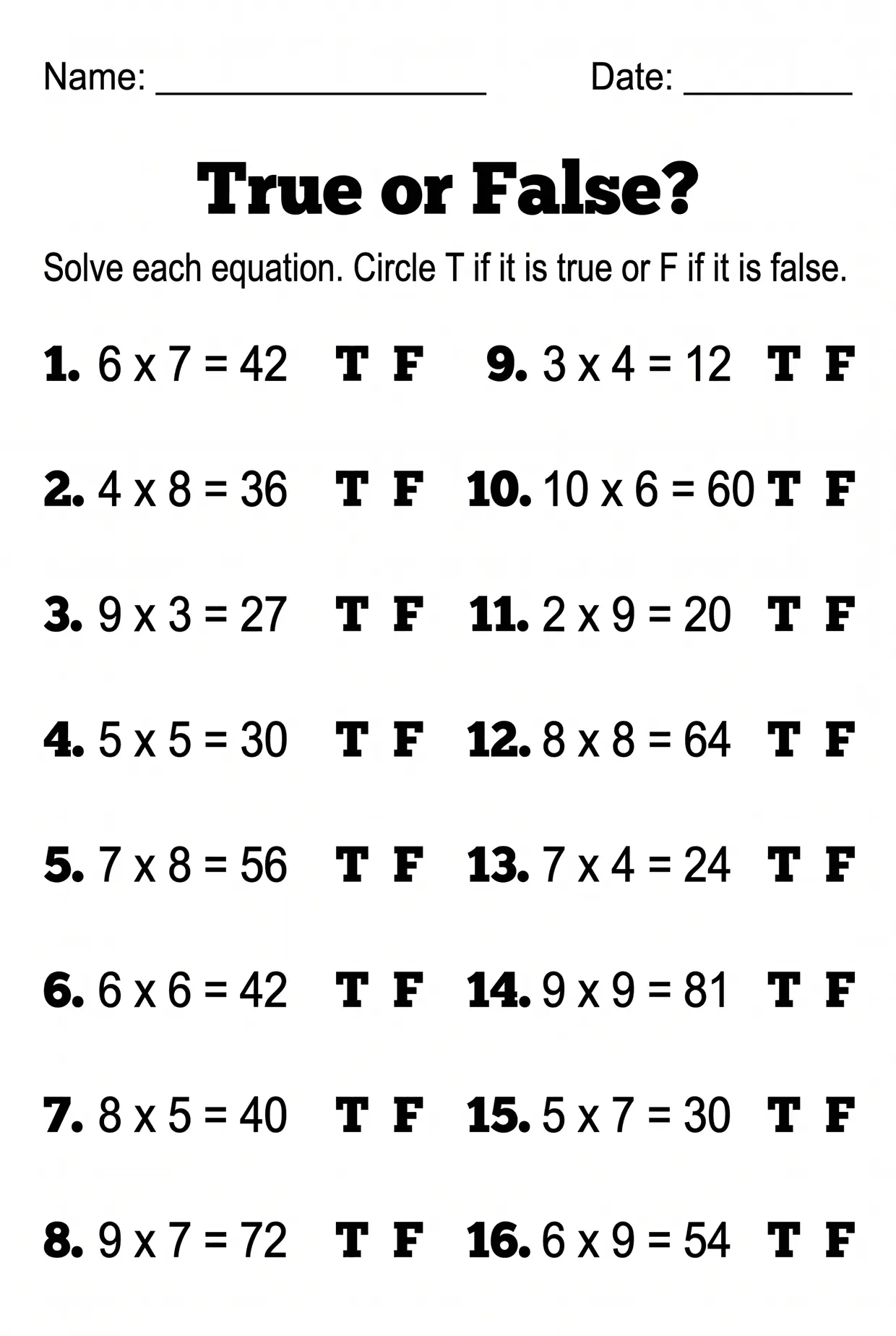
Sixteen equations in two columns, each already carrying an answer, with T and F beside it to circle. Some are right and some are not, and the wrong ones are wrong by a little rather than a lot: 4 x 8 = 36, 5 x 5 = 30, 6 x 6 = 42, 2 x 9 = 20, 5 x 7 = 30 and 9 x 7 = 72 all sit close enough to the true product to catch a child who is guessing.
Judging an answer is harder than producing one, and it is the skill that stops small errors from surviving. A child who can look at 6 x 6 = 42 and know immediately that it is wrong has genuinely internalized the fact. The near-miss answers are also useful to talk through afterward, since most of them come from a real mix-up worth naming, such as reaching for the 7s row while working on the 6s.
What students will practice
- Check whether a multiplication equation is correct
- Spot a product that is close but wrong
- Circle T or F for each equation
Details
- Grade level
- Grade 3
- Subject
- Math · Multiplication
- Pages
- 1
- Format
- PDF · US Letter and A4 included
- License
- Free for classroom use · Attribution appreciated
- Last updated
- September 9, 2026