Math Grade 1
Compare Both Sides: Greater Than Less Than Worksheet
✓ Your download is starting. Thanks for using Nifty Worksheets!
Free · 1-page PDF
No account · No watermarks
Size:
878
Downloads
4.7★
45 ratings
~20 min
Activity time
1 pg
Total pages
About this worksheet
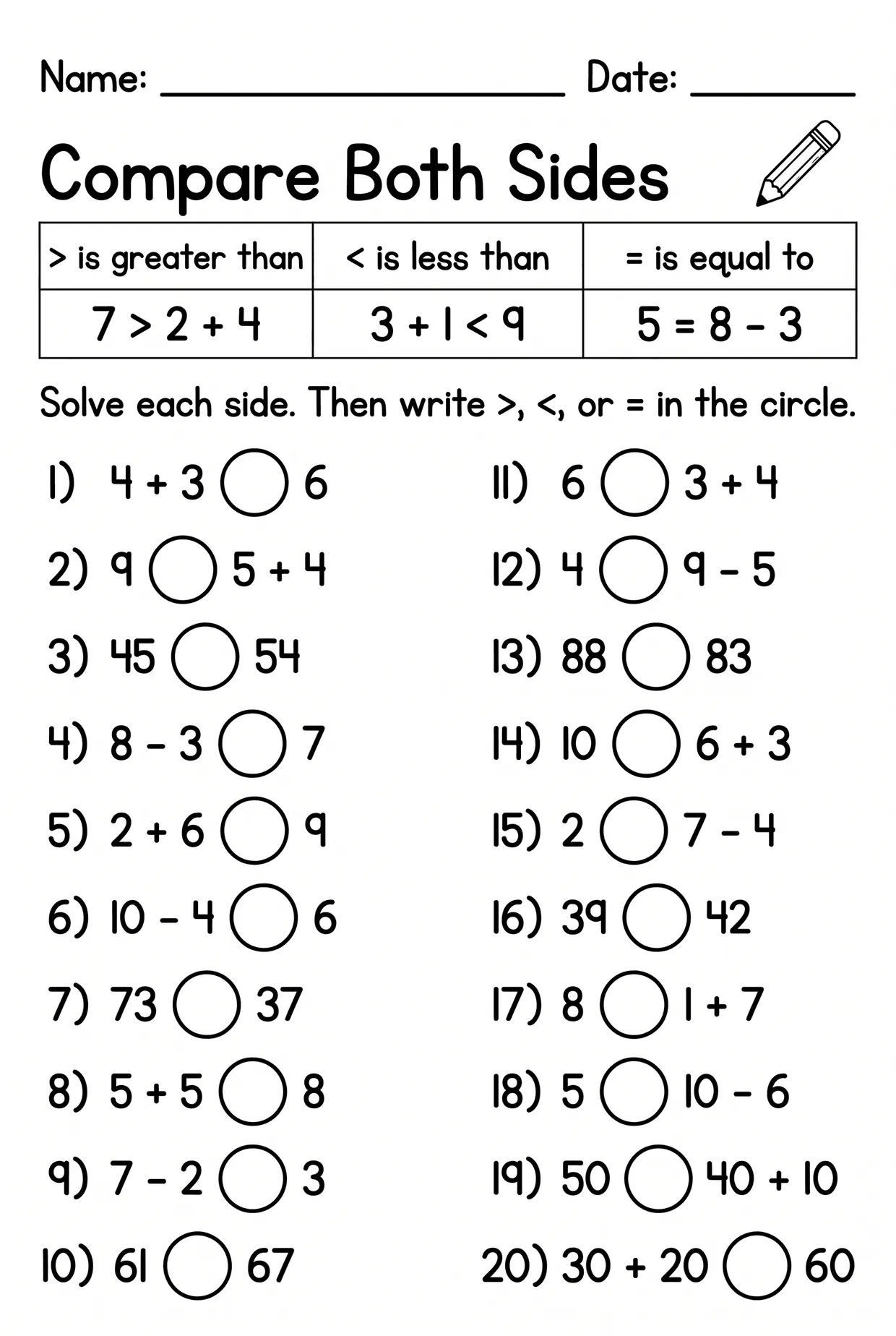
Three worked examples sit under the key at the top, 7 > 2 + 4, 3 + 1 < 9, and 5 = 8 - 3, which is the whole idea of the sheet in one line. Twenty problems follow, and they alternate between plain two-digit pairs like 45 and 54 and problems where one side has to be worked out first, such as 4 + 3 against 6 or 30 + 20 against 60. The child solves each side, then writes the symbol in the circle.
This is the hardest of the set and the one worth saving for last. Seeing = in front of something other than an answer is where a lot of first graders wobble, because up to this point the equals sign has always meant “write the total here.” Problems 19 and 20 are the payoff, both sides needing work before either can be compared.
What students will practice
- Solve a sum or difference before comparing it
- Compare a number to an expression
- Use = to mean both sides are worth the same
Details
- Grade level
- Grade 1
- Subject
- Math · Comparing numbers
- Standard
- CCSS 1.NBT.3 and 1.OA.7
- Pages
- 1
- Format
- PDF · US Letter and A4 included
- License
- Free for classroom use · Attribution appreciated
- Last updated
- September 21, 2026
Pairs well with