Line Up the Numbers: Ascending Order to 30
About this worksheet
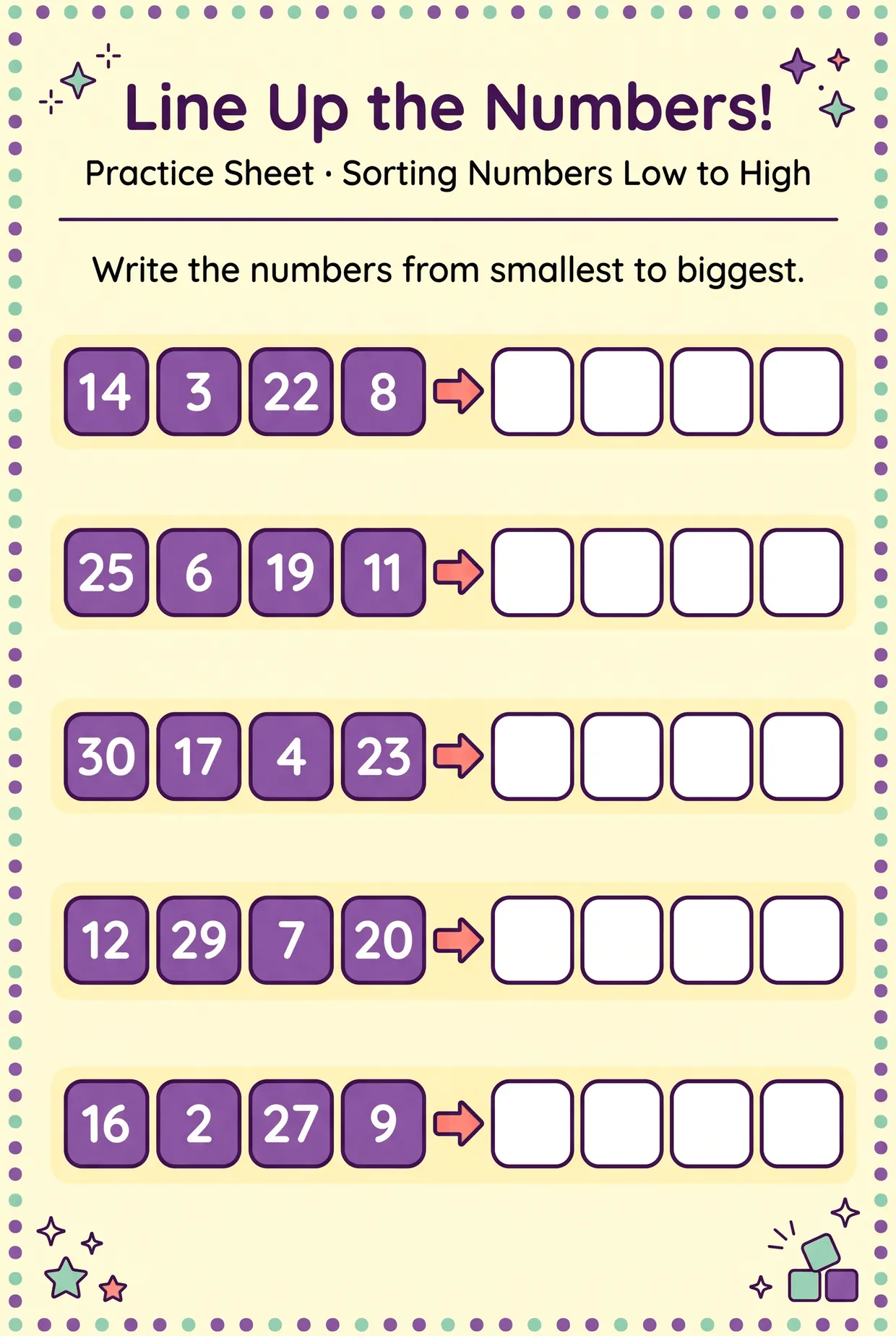
Each of the five rows on this page holds four purple number tiles, an arrow, and four empty boxes. A child reads the tiles, works out the order, and rewrites them into the boxes on the right. The sets reach 30 and deliberately scatter the sizes, so a row like 30, 17, 4, 23 puts the biggest number first and the smallest third. The page sits on soft yellow with a purple dotted border, small stars in the corners, and a stack of blocks at the foot.
Four numbers is a real step up from three, because a child can no longer just spot the smallest and the biggest and fill the middle by default. The tile-to-box layout keeps that harder job readable: the numbers to sort are visibly separate from the answer row, and there is no arithmetic mixed in. There is no name line on this sheet, which makes it easy to reuse as a laminated centre card or a quick reteach page.
What students will practice
- Compare two-digit numbers up to 30
- Order four numbers from smallest to biggest
- Copy numerals into a matching row of boxes
Details
- Grade level
- Grade 1
- Subject
- Math · Ordering numbers
- Pages
- 1
- Format
- PDF · US Letter and A4 included
- License
- Free for classroom use · Attribution appreciated
- Last updated
- July 29, 2026