About this worksheet
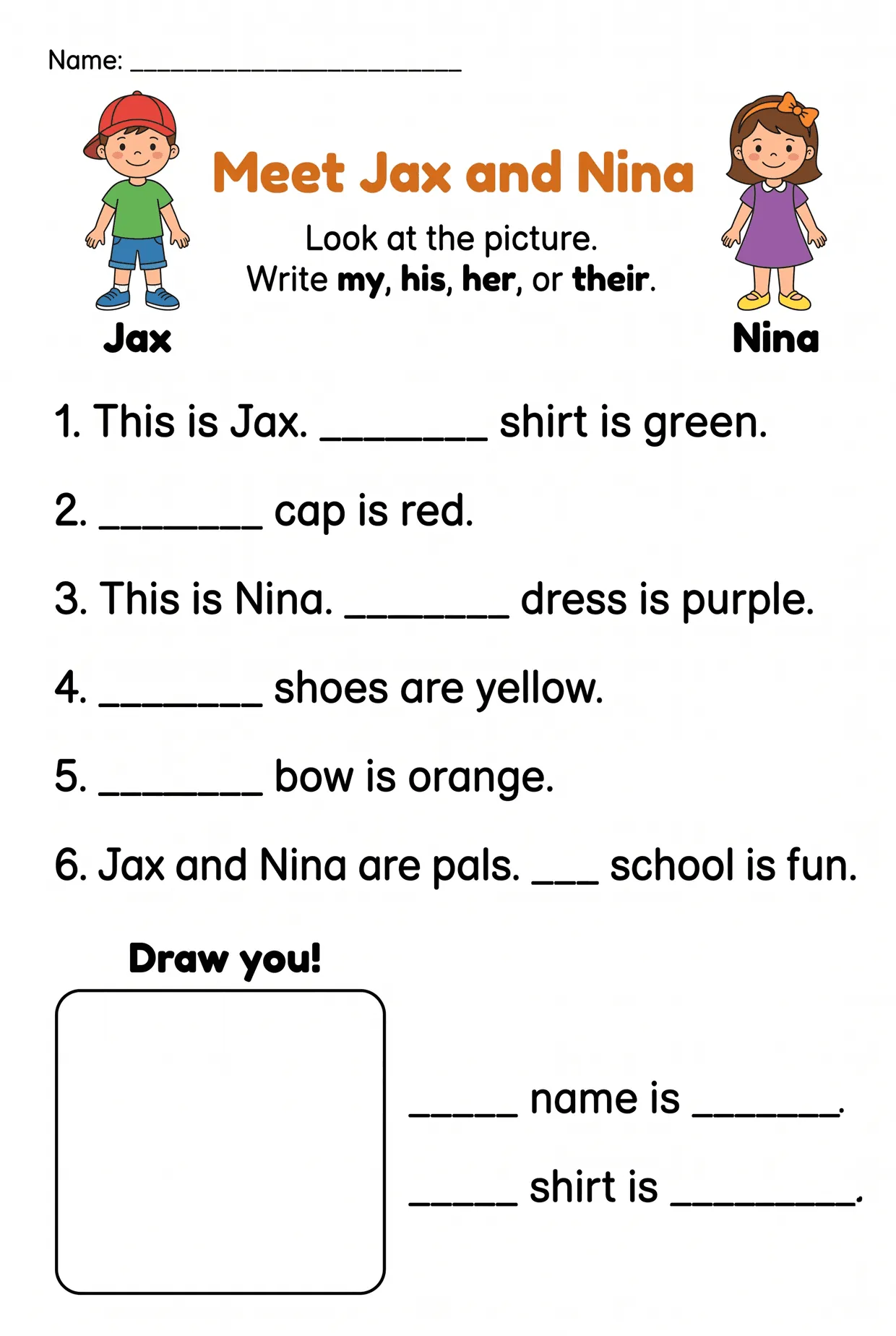
Two characters stand at the top of the page, Jax in a red cap and green shirt, Nina in a purple dress with an orange bow. Six sentences underneath describe what they are wearing, and the child fills in my, his, her or their.
The interesting part is that the subject does not get repeated every time. Sentence one names Jax, and then sentence two just says the cap is red, so the child has to carry him across into the next line. Same with Nina and her dress, shoes and bow. That is a genuinely harder skill than matching one sentence at a time, and it is the reason to use this one after the plainer sheets rather than before.
At the bottom there is a box to draw yourself in, and two lines that start with a blank. My name is, my shirt is. A child who has spent the page writing his and her about other people now writes my about themselves, which is usually the moment the word stops being an abstract one.
What students will practice
- Use his, her and their to describe what you can see
- Carry a subject across more than one sentence
- Write about yourself using my
Details
- Grade level
- Grade 1
- Subject
- Reading · Grammar
- Standard
- L.1.1d
- Pages
- 1
- Format
- PDF · US Letter and A4 included
- License
- Free for classroom use · Attribution appreciated
- Last updated
- September 7, 2026