Reading Grade 3 Conjunctions
Conjunction Match-Up Worksheet for 3rd Grade
✓ Your download is starting. Thanks for using Nifty Worksheets!
Free · 1-page PDF
No account · No watermarks
Size:
516
Downloads
4.7★
16 ratings
~10 min
Activity time
1 pg
Total pages
About this worksheet
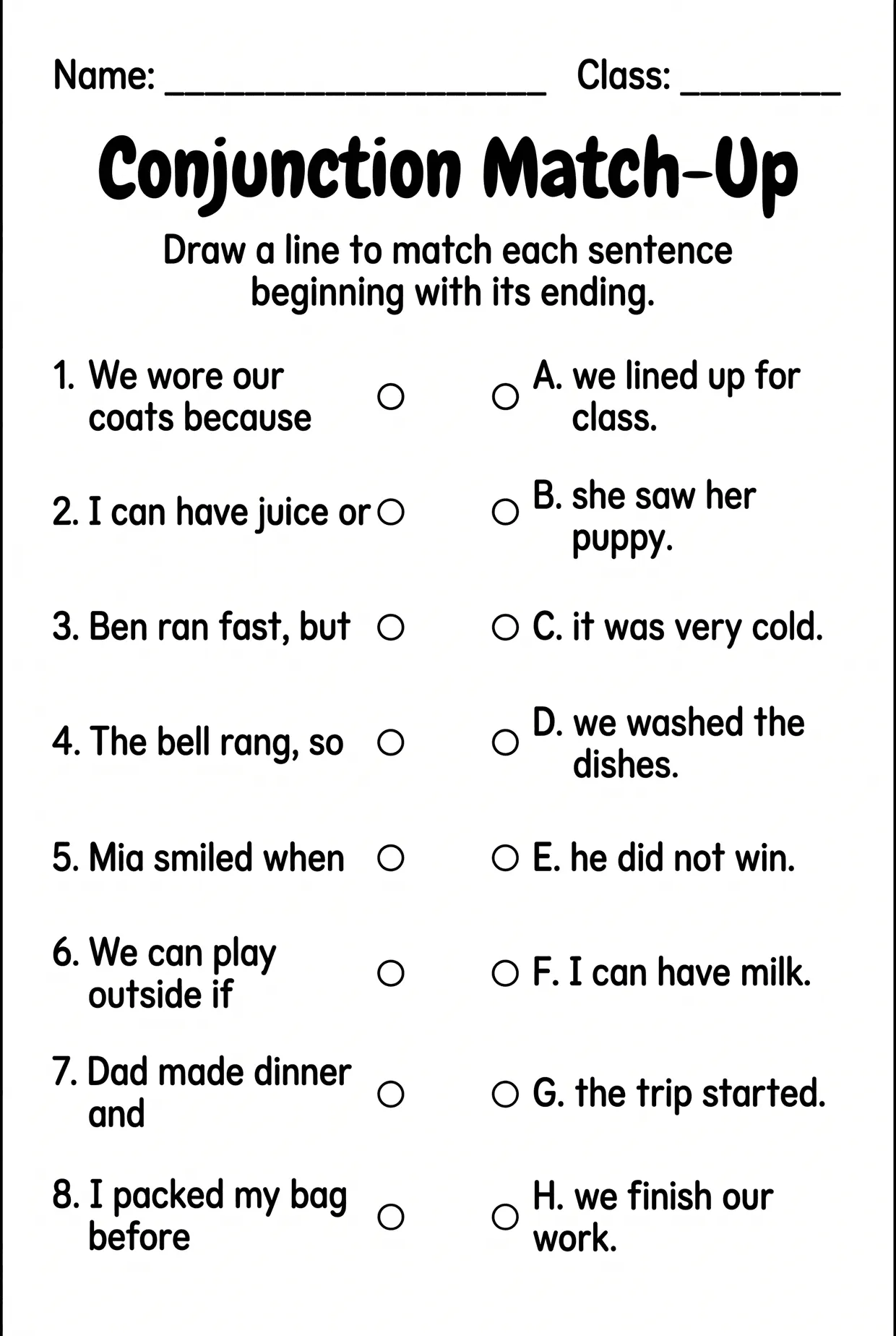
Eight sentence beginnings down the left, each stopping right after its conjunction: We wore our coats because. Ben ran fast, but. We can play outside if. Eight endings sit down the right, and the child draws a line to join each pair.
Every conjunction points somewhere different. Because is followed by a reason, but by something unexpected, so by a result, if by a condition. A child who reads Ben ran fast, but and expects a surprise will reach for he did not win, which is exactly the thinking conjunctions are meant to build.
There is no writing at all, so it works well as a warm-up, and once most pairs are joined the last few can be solved by checking what is left.
What students will practice
- Use a conjunction to predict how a sentence will finish
- Match because, but, so, when, if and before to their meaning
- Read whole sentences to check they make sense
Details
- Grade level
- Grade 3
- Subject
- Reading · Grammar
- Standard
- CCSS L.3.1.h
- Pages
- 1
- Format
- PDF · US Letter and A4 included
- License
- Free for classroom use · Attribution appreciated
- Last updated
- September 13, 2026
Pairs well with