About this worksheet
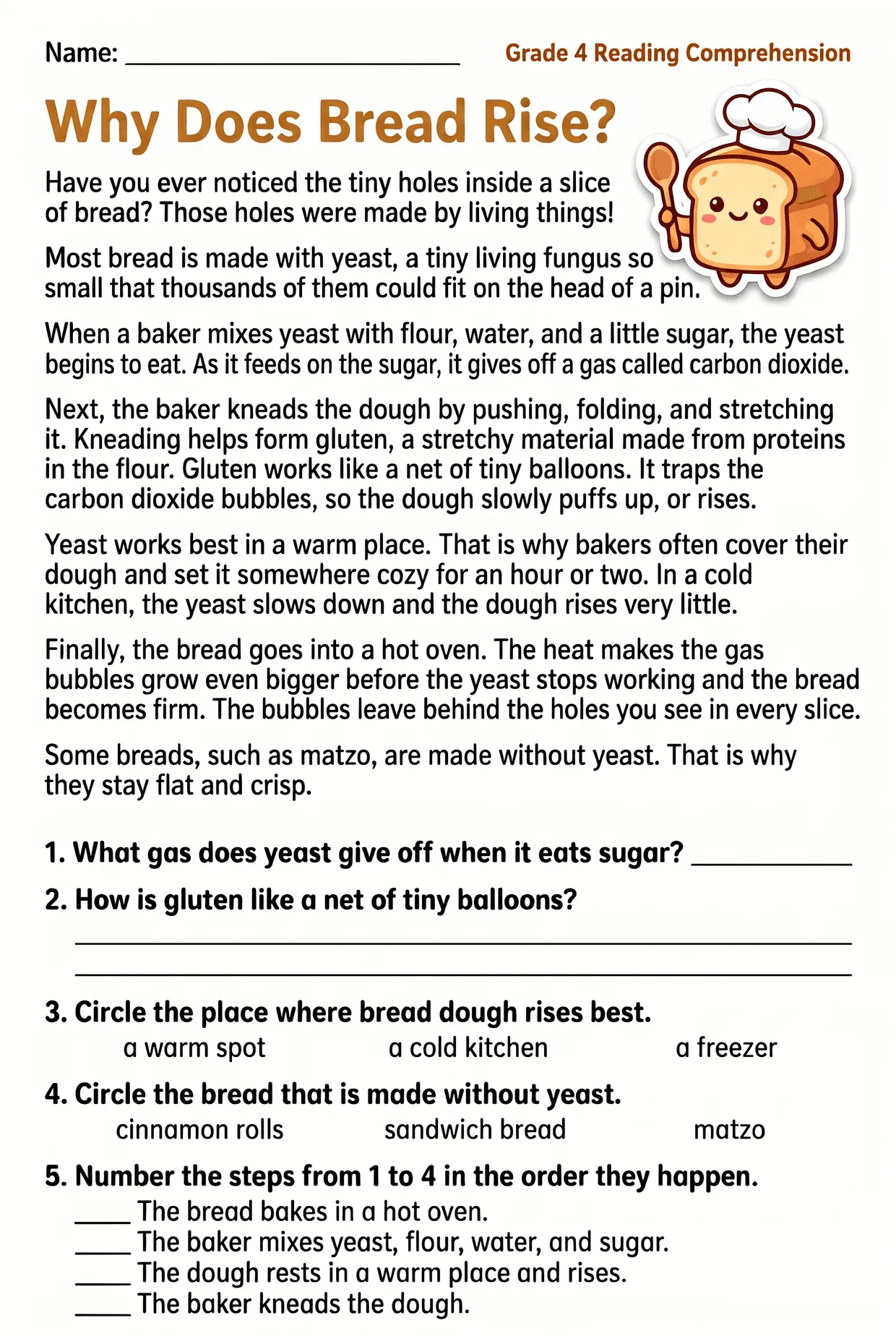
The holes in a slice of bread were made by living things. This passage explains how yeast feeds on sugar and gives off carbon dioxide, how kneading builds gluten that traps the bubbles like a net of tiny balloons, why dough rises best somewhere warm, and why matzo stays flat.
It reads as a process from mixing to baking, and question five checks that a child followed it by numbering four steps in order. Question two asks how gluten is like a net of balloons, which is a good way into how science writers use comparisons. A fun one to pair with a real loaf if you have a kitchen handy.
What students will practice
- Explain a scientific process using details from the text
- Put the steps of a process in order
- Understand a comparison the author uses to explain an idea