Farm Animals Tracing Worksheet: Barnyard Words

Eight barnyard animals with a dotted word under each: goat, chick, pony, bunny, lamb, goose, cow and mouse. A color strip of silo, windmill, hay bales and pumpkins runs across the top, and a wooden fence closes the bottom.
This is the right opener for a three or four year old because nothing on it asks for decoding. Every word names an animal the child can already see, so the whole job is keeping a pencil on the dotted line, then coloring what they traced.
Farm Animals Counting Worksheet: How Many? 1 to 5
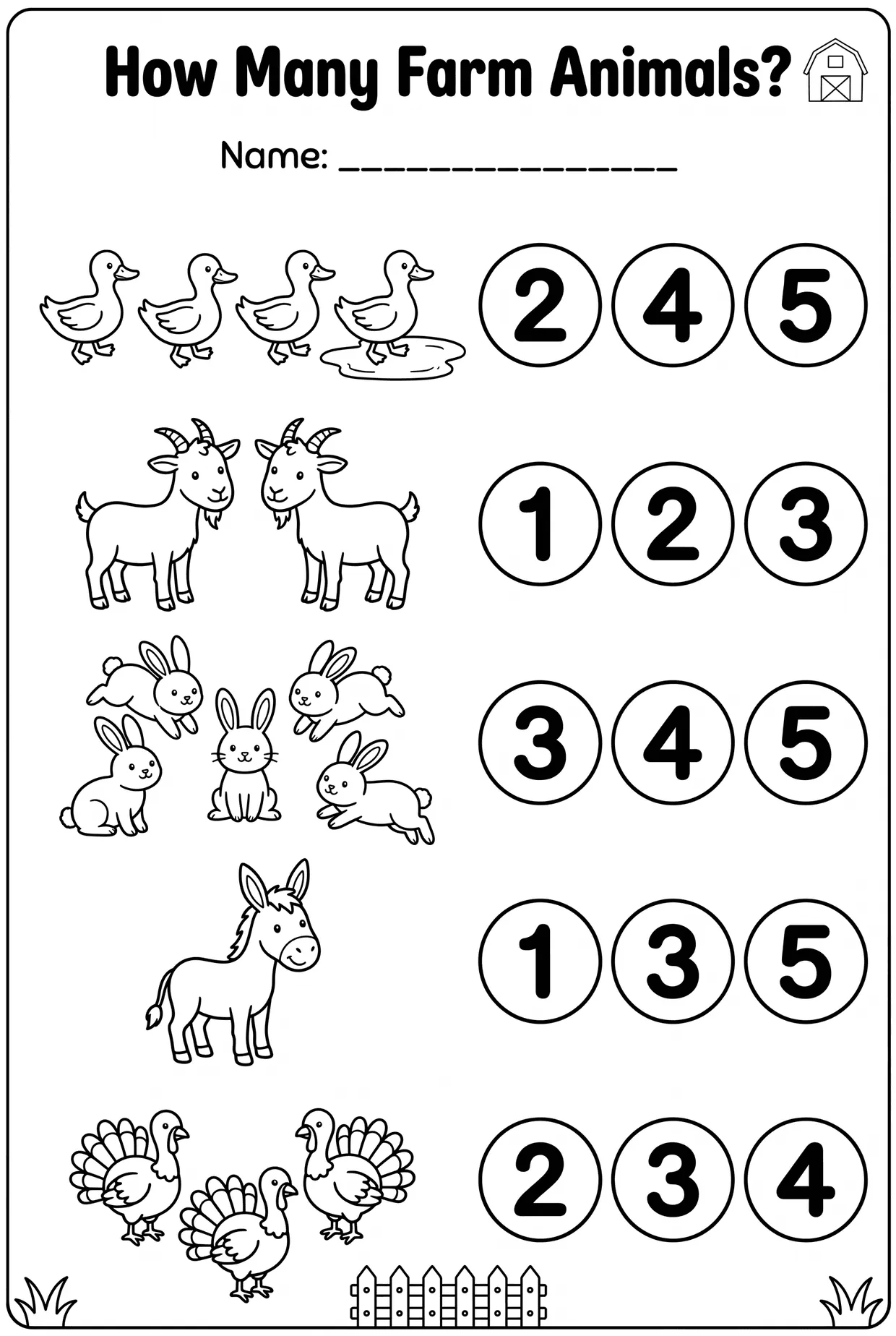
Five rows of animals with three numbered circles beside each: four ducks, two goats, five bunnies, one donkey, three turkeys. Count the group, circle the number.
The answer gets circled rather than written, and that is the whole reason this sits at Pre-K. Children can count a group of five accurately well before they can form the numeral, and this lets them show it without the pencil work getting in the way.
Count the Farm Animals Worksheet: Numbers 1 to 5
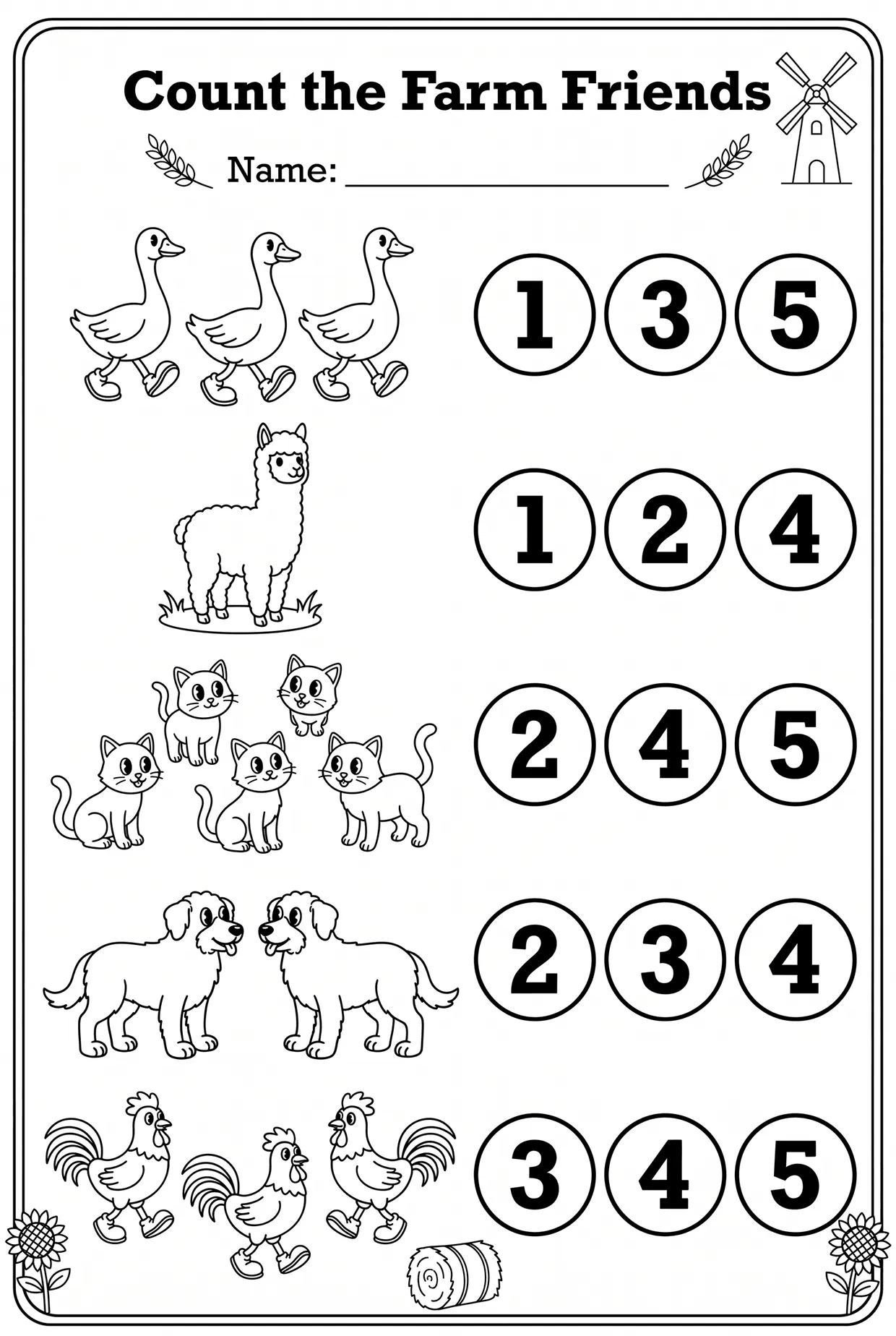
Same count-and-circle format, new animals: three geese in boots, one llama, five kittens, two puppies, three roosters.
Counting is the skill that most rewards a second pass, and swapping the animals keeps a child looking at the group instead of remembering yesterday's answer. The scattered kittens are the telling row here.
Farm Animals Tracing Worksheet: Ram, Piglet, Llama
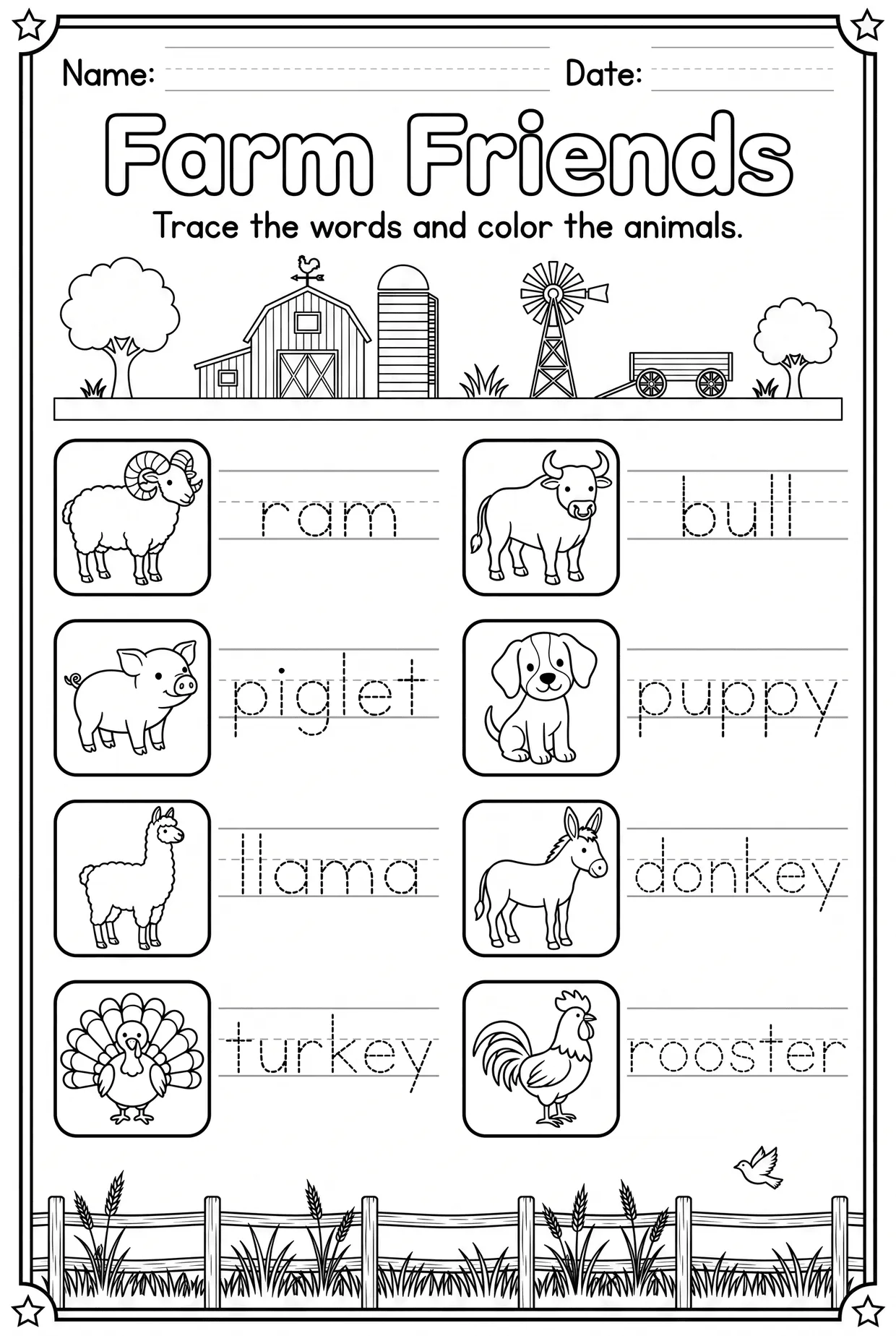
The step up from sheet 01: ram, bull, piglet, puppy, llama, donkey, turkey and rooster, each in a framed picture with a dotted word beside it. Barn, silo, windmill and wagon along the top, wheat and fence at the bottom, all of it line art.
Ram and bull go quickly. Piglet, donkey, turkey and rooster run six and seven letters, which asks for more stamina and steadier letter formation than a preschooler usually has, so this one belongs in Kindergarten.
Farm Animals Word Scramble Worksheet: Hen to Rabbit
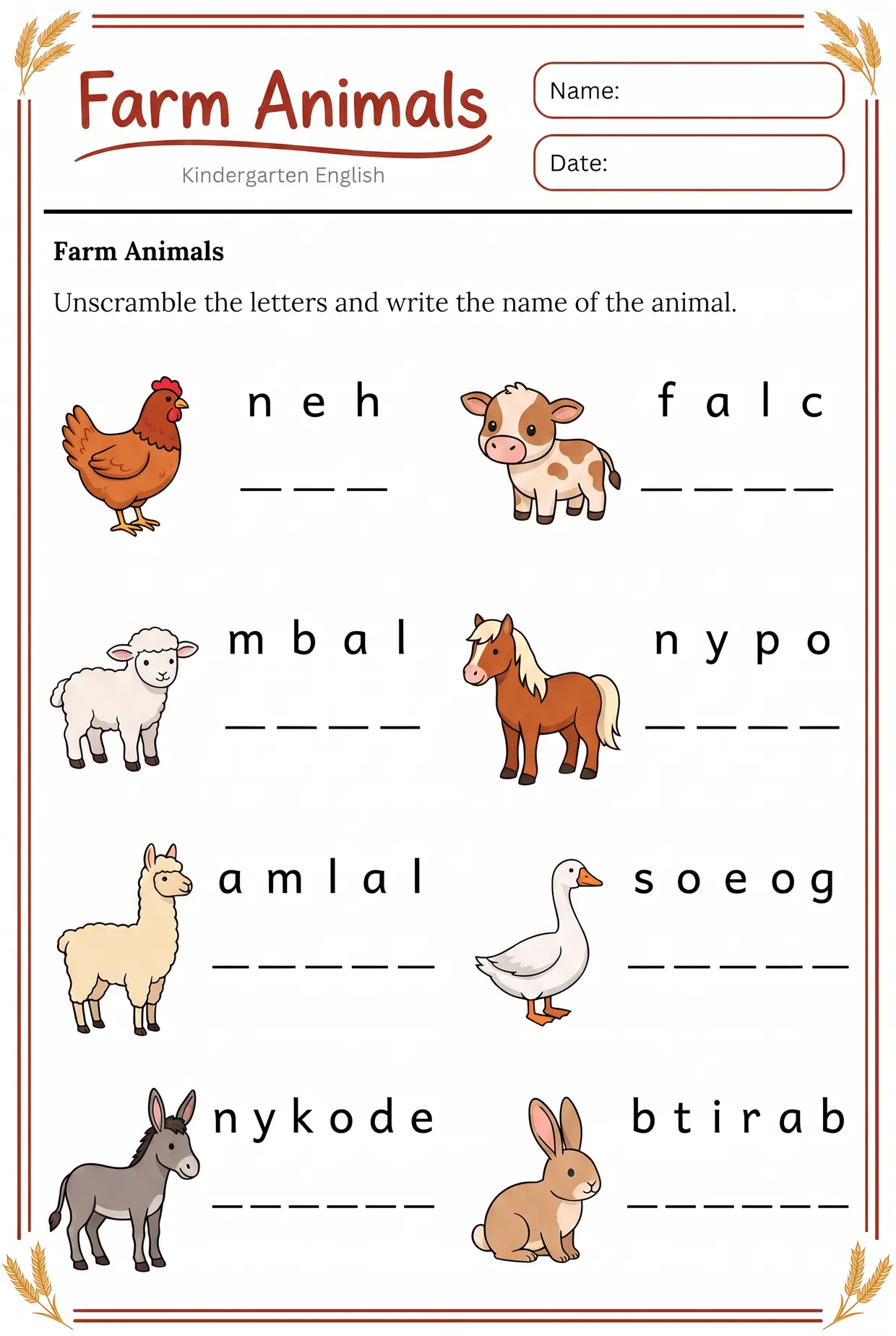
Eight color animals with their names jumbled beside them: hen, calf, lamb, pony, llama, goose, donkey and rabbit. Name the animal, unscramble the letters, write the word.
A scramble hands over every letter, so the child is ordering rather than recalling a spelling, and the picture settles which word it is. Donkey and rabbit at the bottom are the genuine stretch, and plenty of kindergartners will want a hand there.
Farm Animals Missing Vowels Worksheet: Down on the Farm
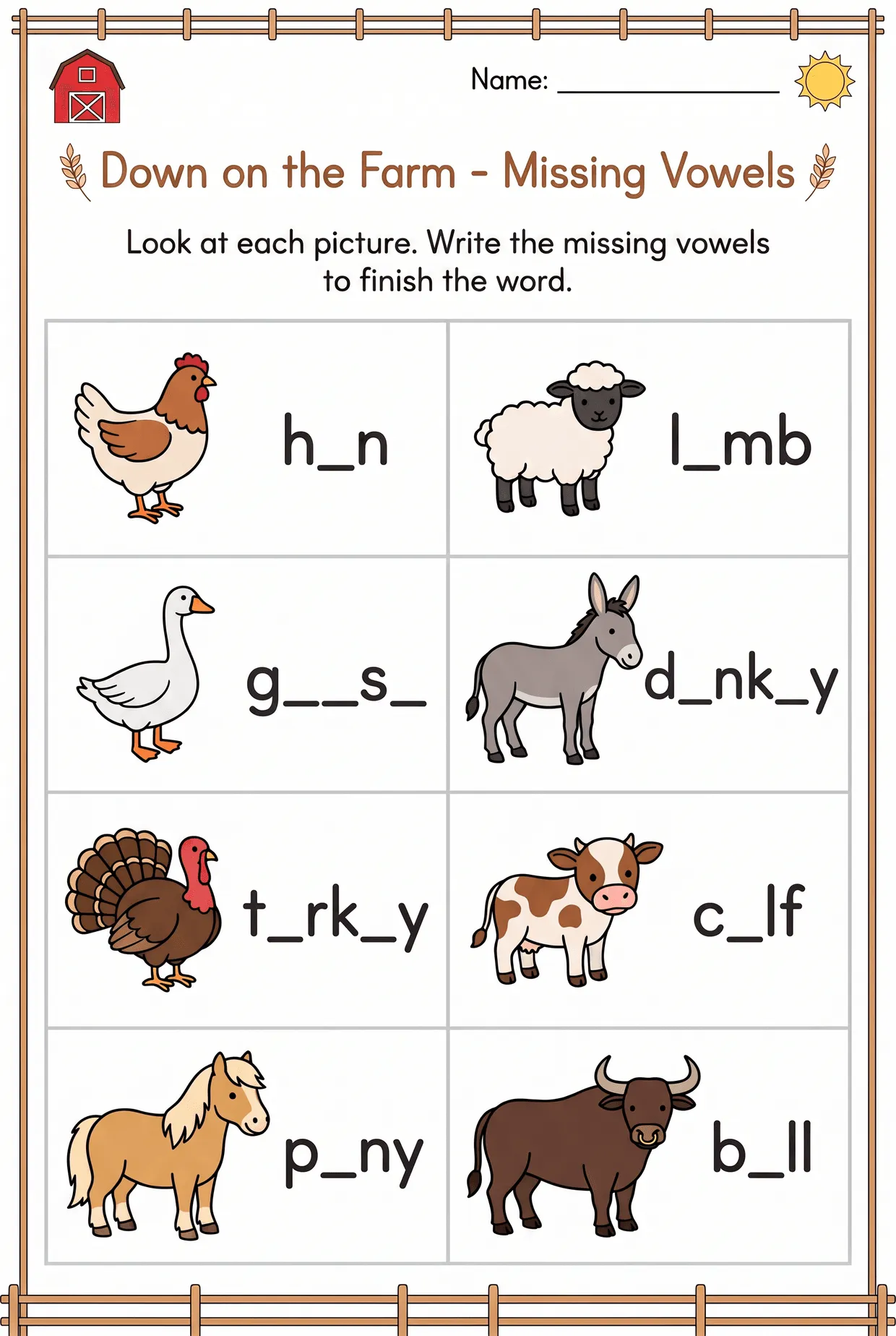
Eight soft-color animals inside a wooden fence border, each missing the vowels from its name: hen, lamb, goose, donkey, turkey, calf, pony and bull.
The word set climbs down the page. Hen and lamb are one short vowel each and go straight in, while goose, donkey and turkey each want a two-letter answer and some thought about which team makes the sound.
Farm Animals Missing Vowels Worksheet: Vowel Hunt
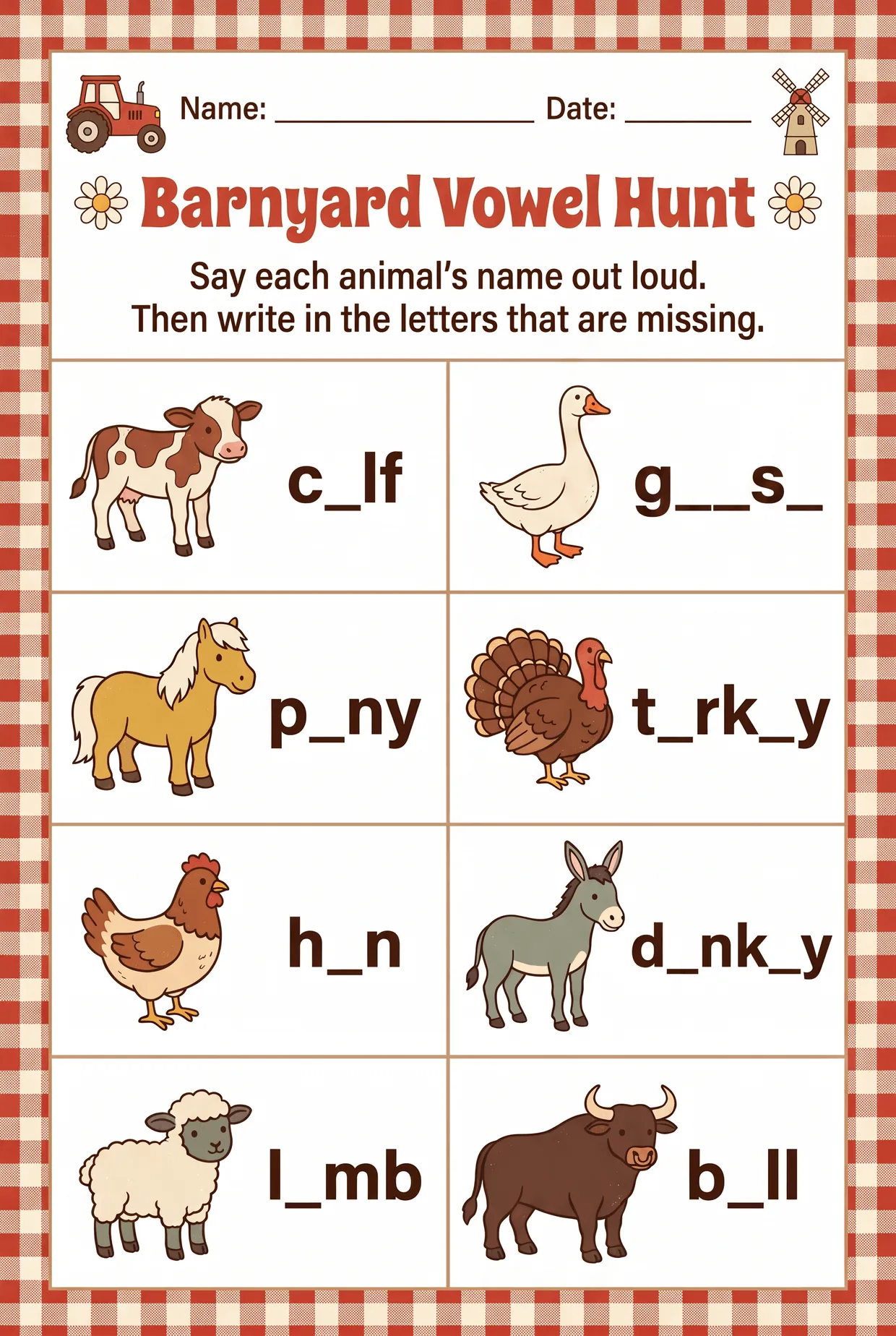
The same eight animals in a red gingham frame, with one instruction added: say the animal's name out loud first, then write in the missing letters.
That ordering is the entire method. A child who sounds out goose hears the long vowel before they have to decide which letters make it, which turns a puzzle into phonics practice.
Color and Spell Farm Animals Worksheet: Missing Vowels
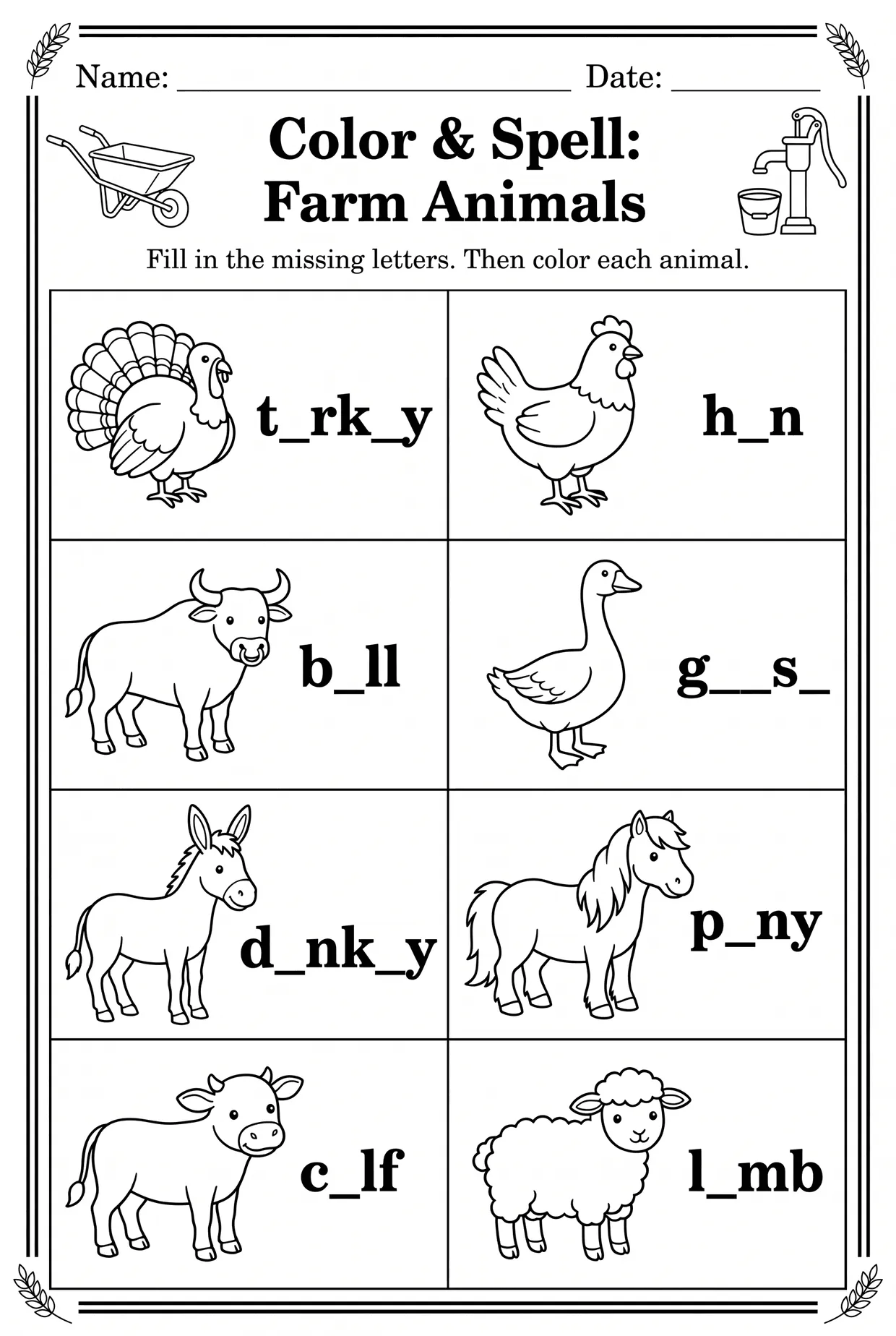
The same eight animals again, this time as clean line art: turkey, hen, bull, goose, donkey, pony, calf and lamb. Fill in the letters, then color.
Dropping the color changes the work more than it looks like it should. On the full-color sheets the animal is unmistakable at a glance; here a child spends a beat longer deciding what they are looking at, which pushes them toward the word instead of the picture.
Farm Animals Missing Letters Worksheet: Pig, Goat, Barn
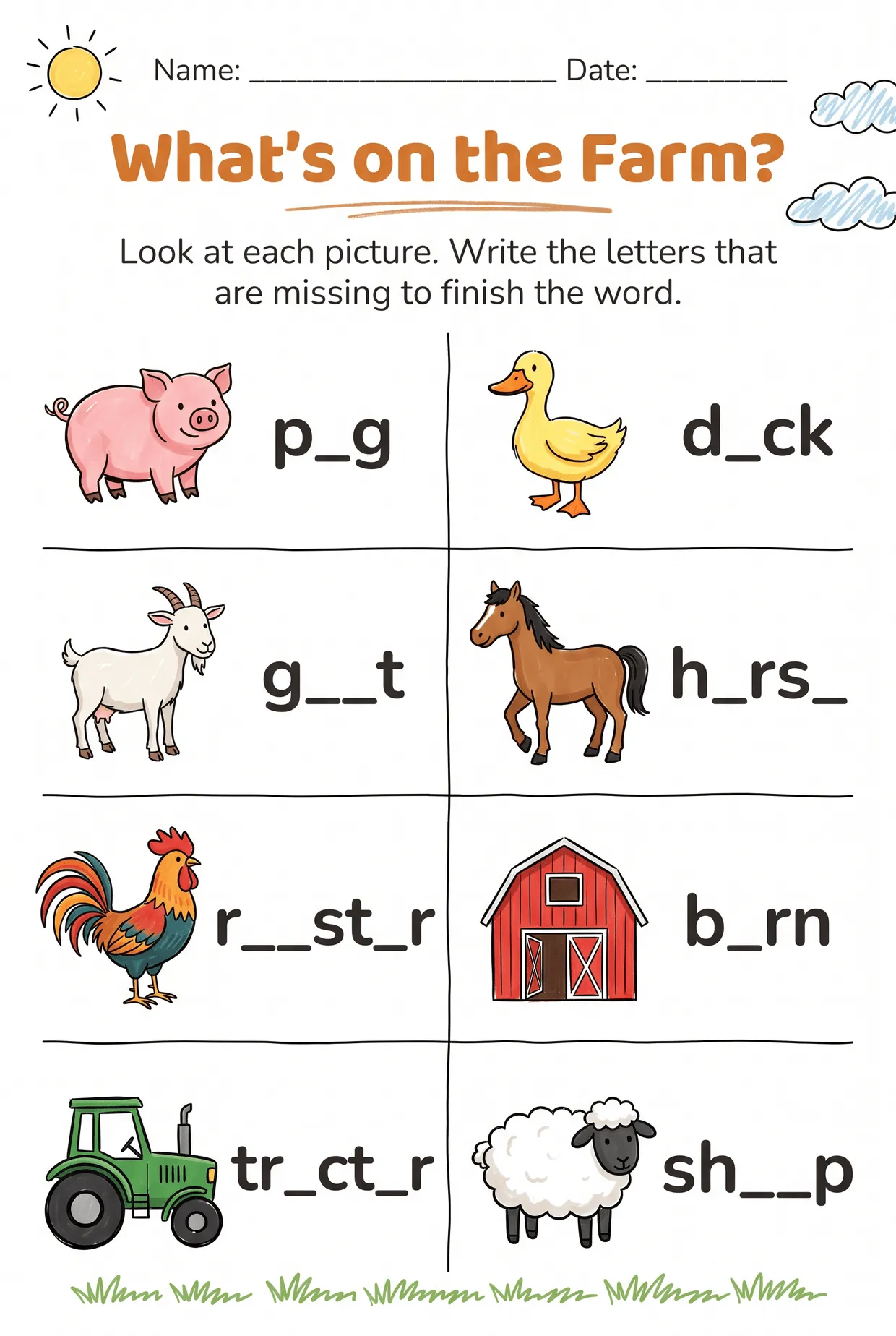
Eight bright pictures under a sun and clouds: pig, duck, goat, horse, rooster, barn, tractor and sheep. Finish each word from the picture.
Goat, sheep and rooster are the reason this is a first grade sheet. Each one needs a vowel team, and a child who has only met short vowels will write got and shep with total confidence. Pig, duck and barn open the page with easy wins on purpose.
Farm Missing Letters Worksheet: Hay, Boots, Wagon
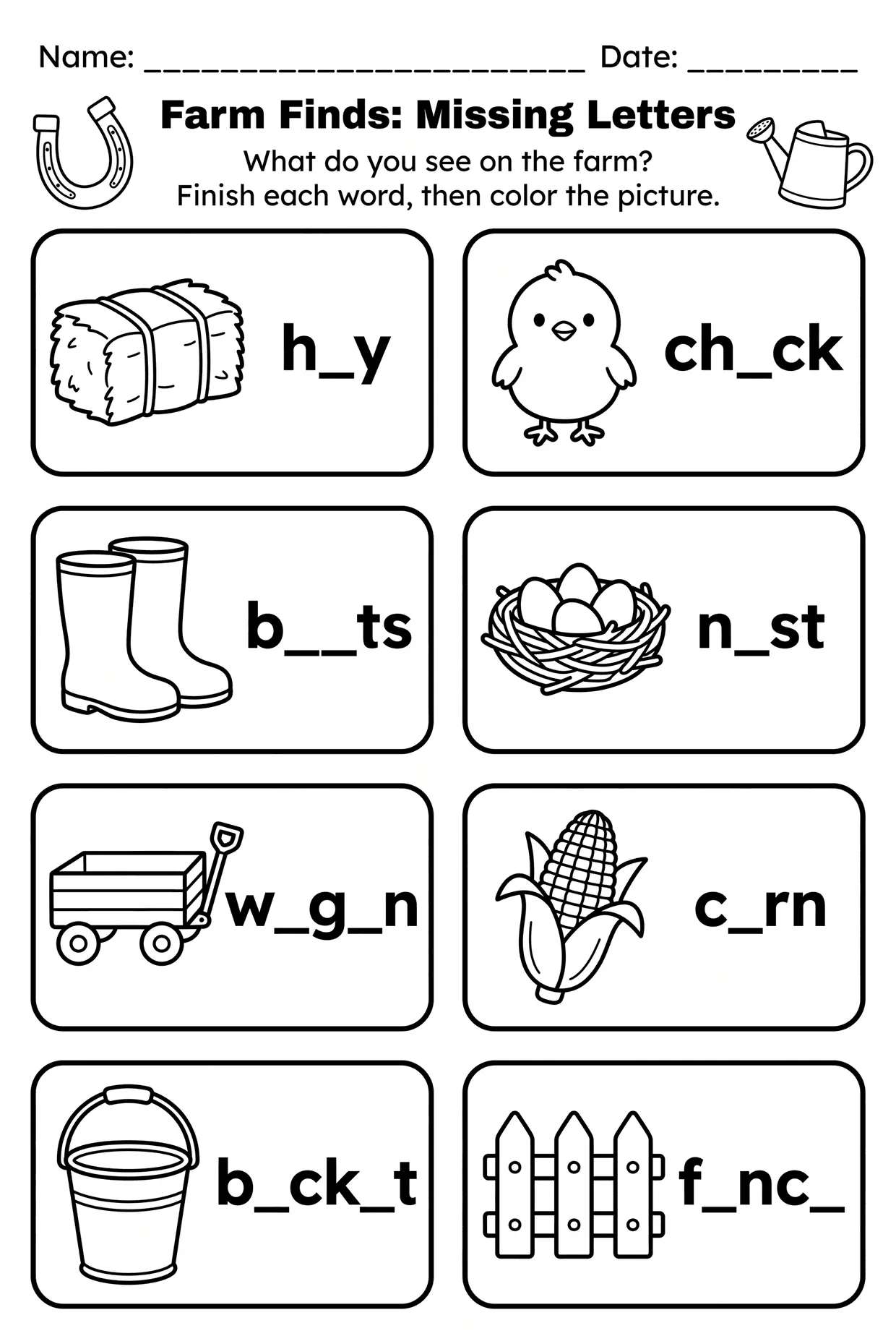
The odd one in the set, deliberately. Eight line-art pictures to finish and color, and only one of them is an animal: hay, chick, boots, nest, wagon, corn, bucket and fence.
This is the stuff a child sees on a farm visit and rarely gets asked to spell, the boots by the door and the bucket and the corn. Wagon, bucket and fence each need two letters filled in, which is what places it at first grade.
Farm Animals Word Search Worksheet: Who Lives Here?
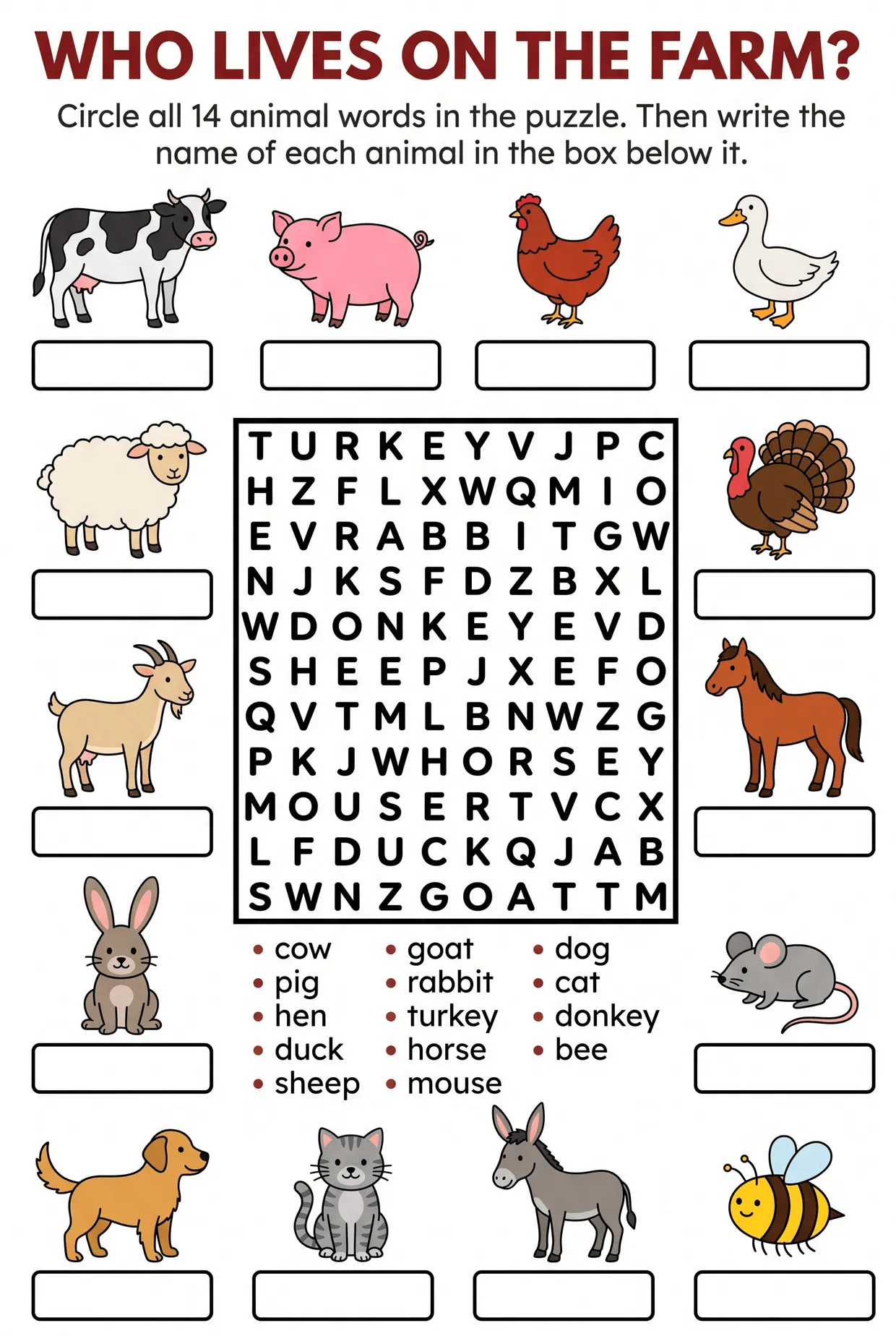
Twelve color animals around a letter grid, each with an empty box beneath. Circle all 14 words, then write each animal's name: cow, pig, hen, duck, sheep, goat, rabbit, turkey, horse, mouse, dog, cat, donkey and bee.
The everyday vocabulary makes this the gentler of the two word searches. A first grader who knows cow, pig and dog on sight fills several boxes fast and has attention left over for sheep, mouse and donkey.
Farm Animals Word Search Worksheet: Label 16 Animals
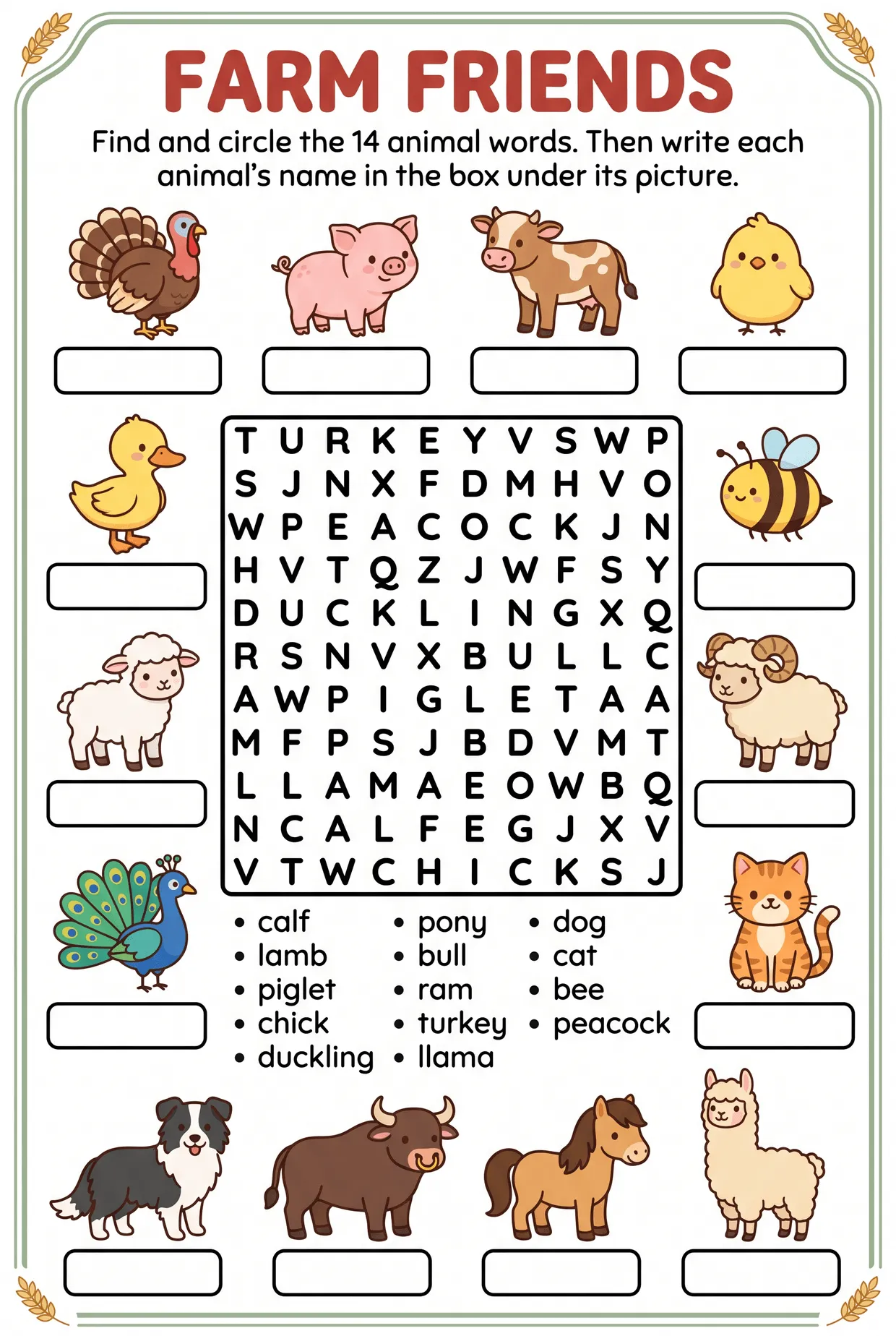
Sixteen animals ringing a word search, with 14 words to find and every picture needing a label: calf, lamb, piglet, chick, duckling, pony, bull, ram, turkey, llama, dog, cat, bee and peacock.
The two halves ask for different things and the second is harder. Circling a word in a grid is pattern matching, but an empty box gives a child nothing to copy, so they have to produce the spelling themselves.
Farm Animals Follow the Directions Worksheet Grade 1
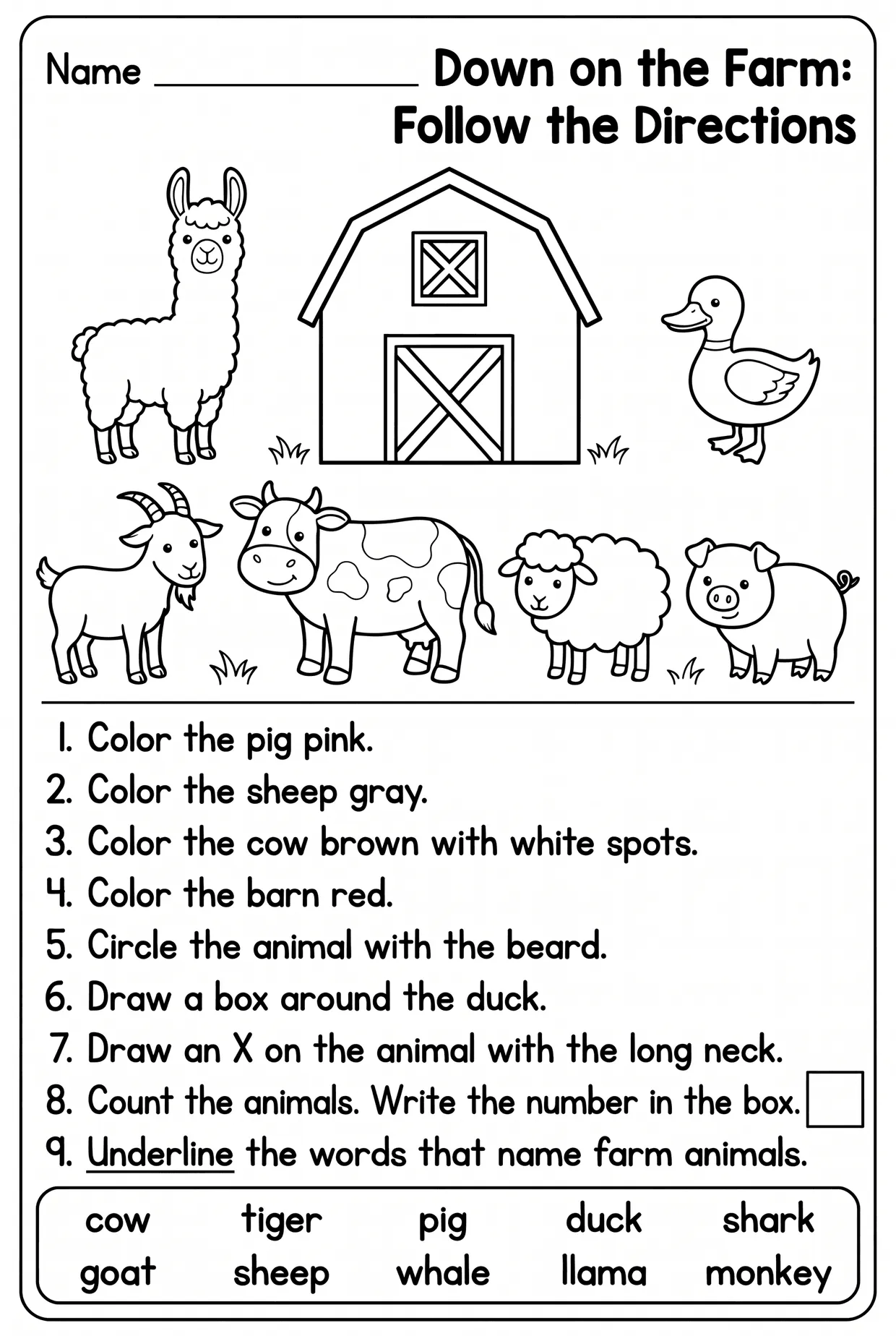
A line-art farm scene and nine numbered directions. Color the pig pink. Color the barn red. Circle the animal with the beard. Draw an X on the animal with the long neck. Count the animals and write the number. Underline the words that name farm animals, in a bank that quietly slips in tiger, whale, shark and monkey.
Two of those directions carry the sheet. Neither the beard nor the long neck names the animal, so a child has to read the clue, look back at the picture and decide. That is a comprehension move dressed up as a coloring instruction.
One more thing.
If your kids finish a unit and you're not sure what to do next, my honest advice: don't move on yet. Spend a week mixing these in as warm-ups. Fluency isn't a unit, it's a habit, and the sheet that builds it is usually the one they ask to do again.