Nifty Worksheets · Roundups · Reading

11Free Adjectives Worksheets for First Grade

Eleven free adjectives worksheets in the order I would actually hand them out. Adjectives look like the easy part of grammar, because every child can already say the big dog, and that is exactly the trap: recognizing a describing word in someone else's sentence and producing one from nothing are different skills, and a child can be fluent at the first while stuck on the second. So this set starts with pictures where the describing word is impossible to miss, works through sorting and sentence-finding in the middle, and finishes with a page that hands over a noun and no word bank at all. Skip to whichever group matches what your child can already do.

In this roundup

The full list

  1. Adjectives Tracing Worksheet: Trace, Write, Color
  2. Match the Adjectives Worksheet: Picture to Word
  3. Adjectives Worksheet: Colors and Patterns in Pictures
  4. Sort the Adjectives Worksheet: Size, Feeling, Texture
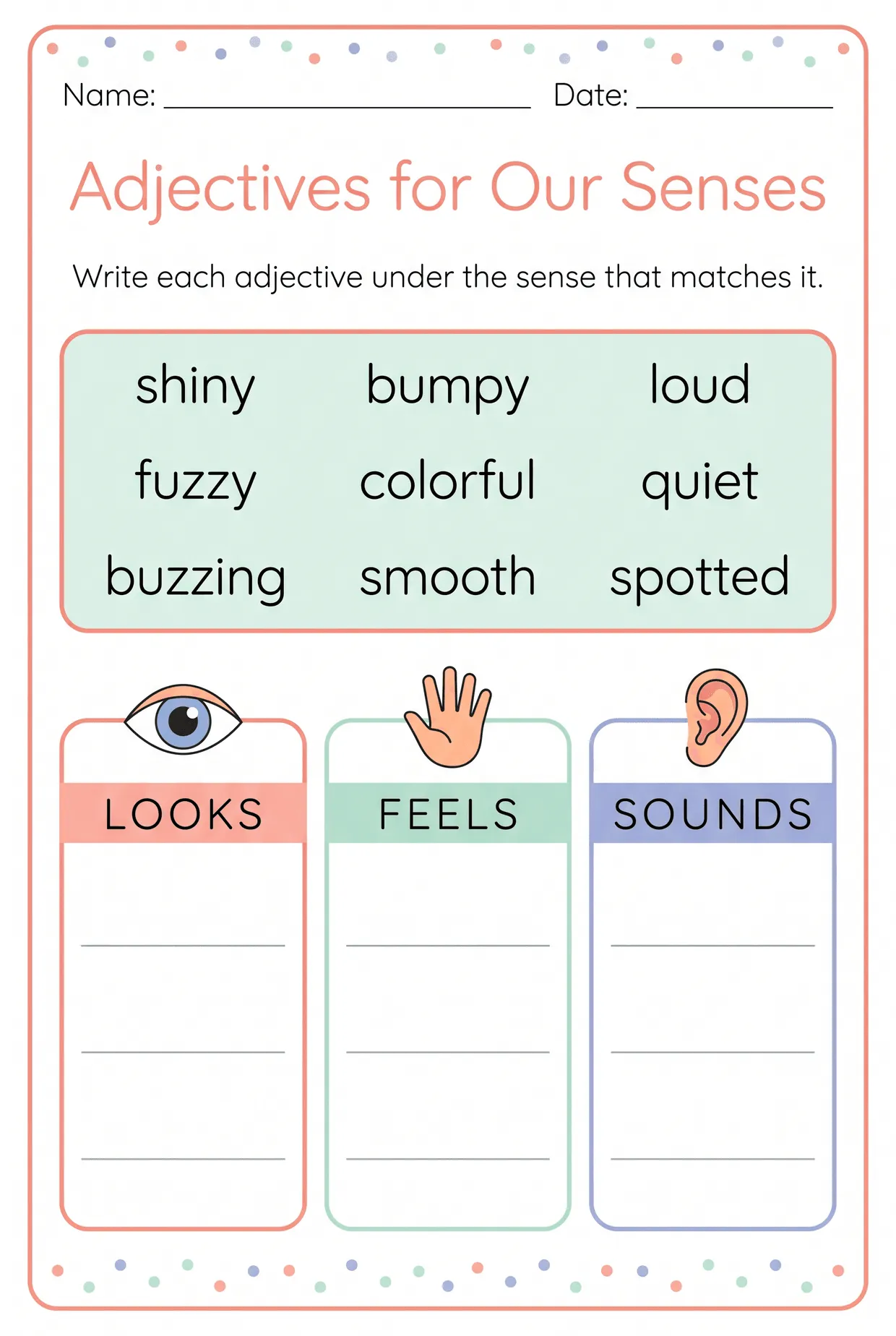
  5. Five Senses Adjectives Worksheet: Looks, Feels, Sounds
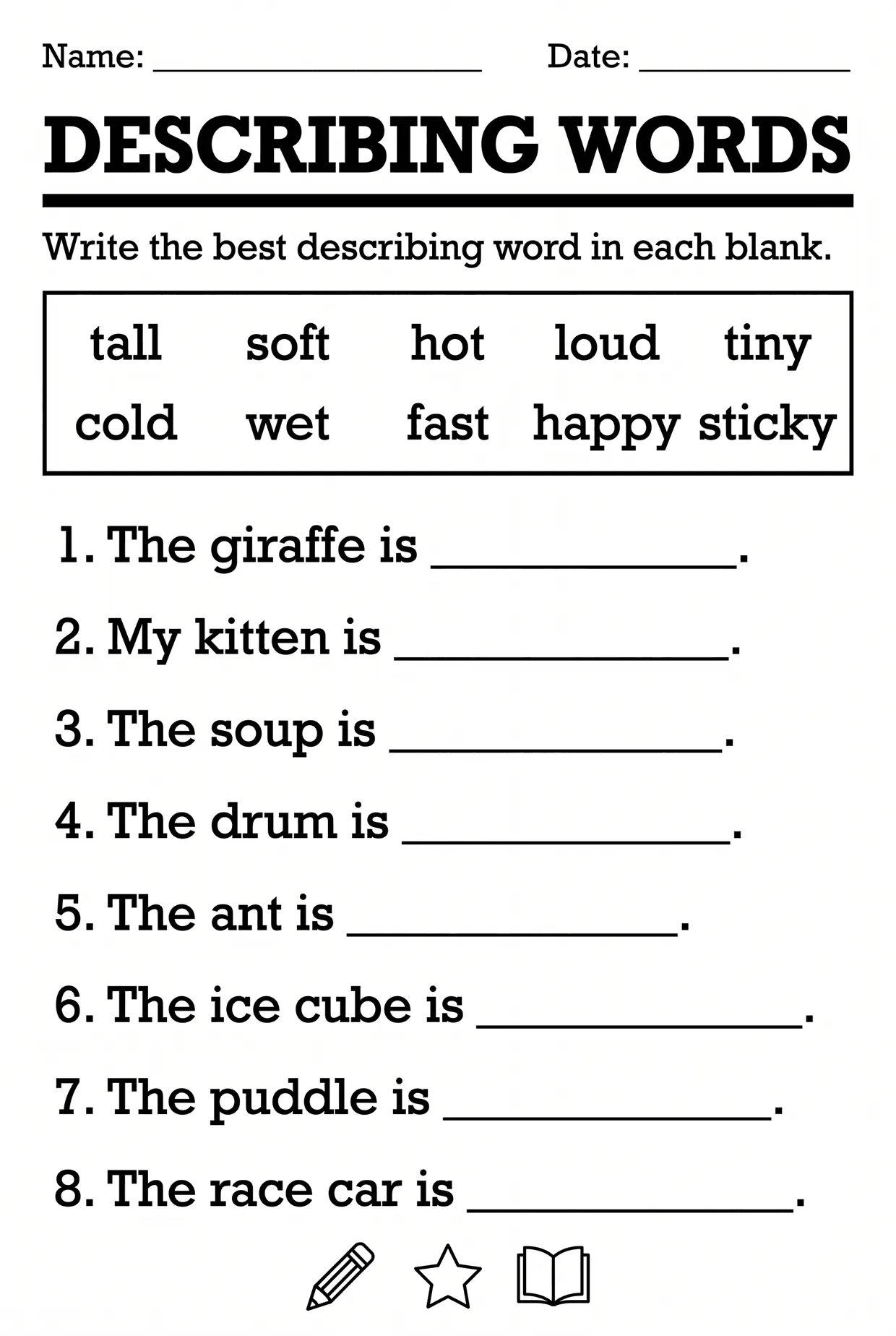
  6. Adjectives Worksheet: Fill In the Describing Word
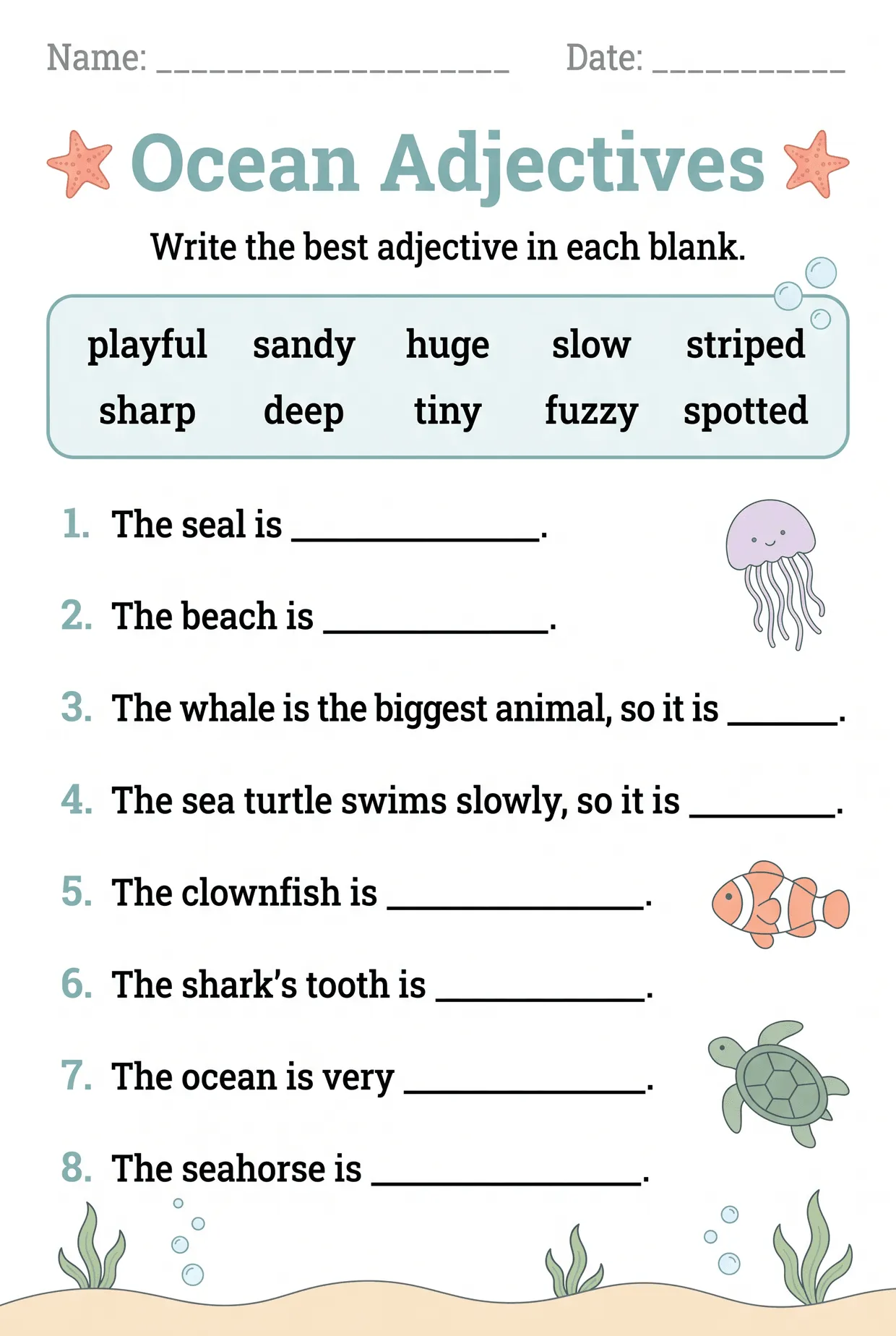
  7. Ocean Adjectives Worksheet: Describe the Sea
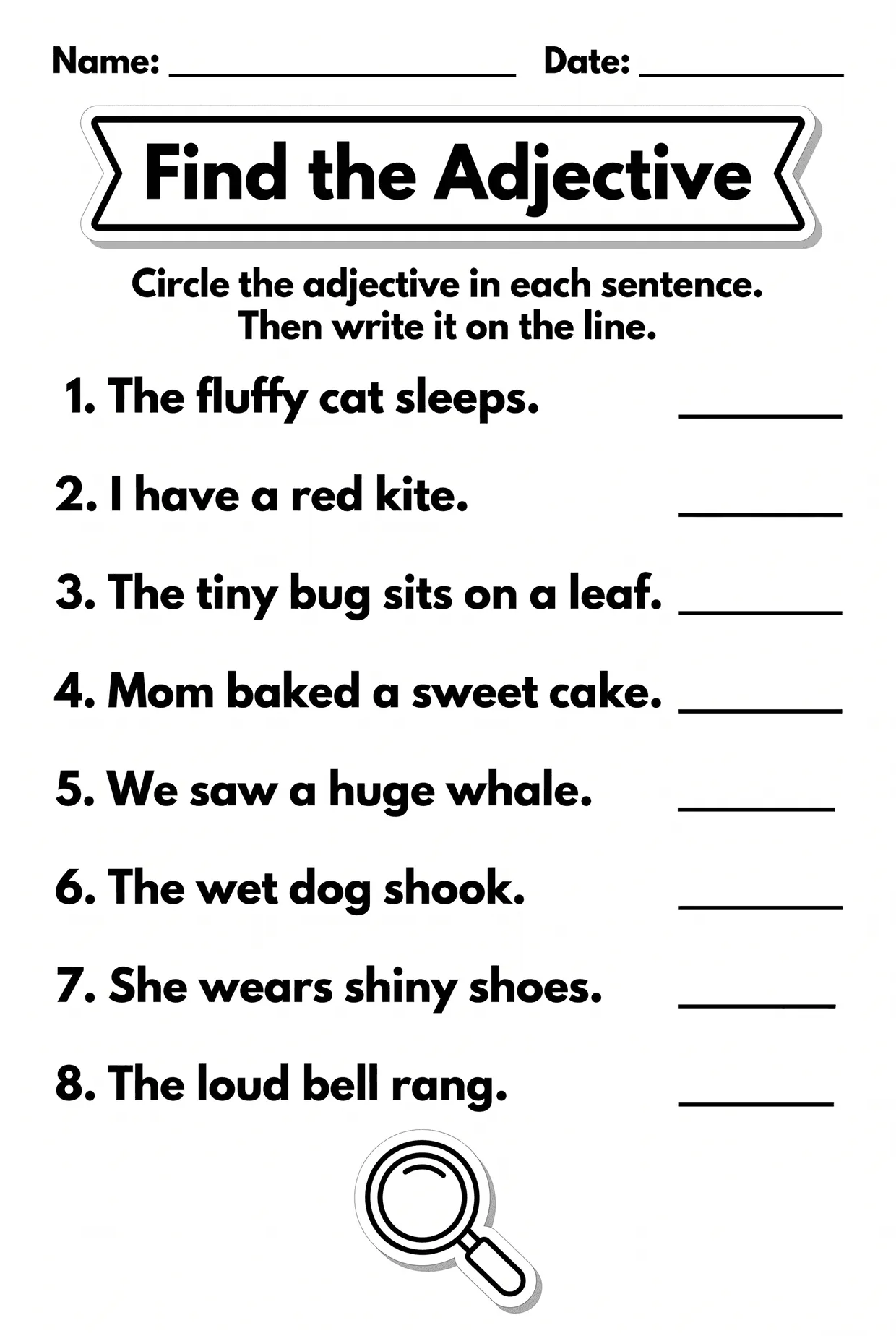
  8. Find the Adjective Worksheet: Circle and Write It
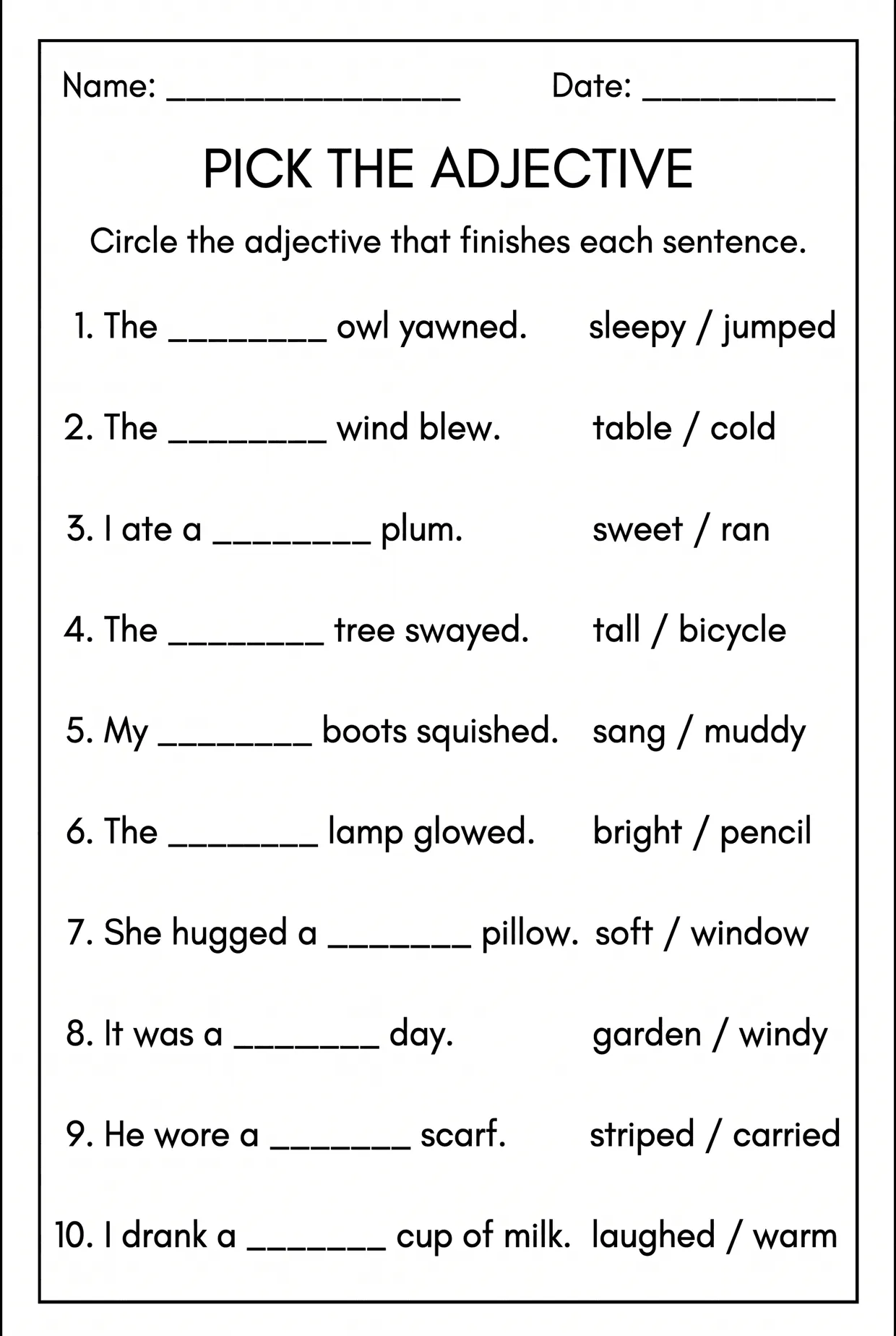
  9. Pick the Adjective Worksheet: Circle the Right Word
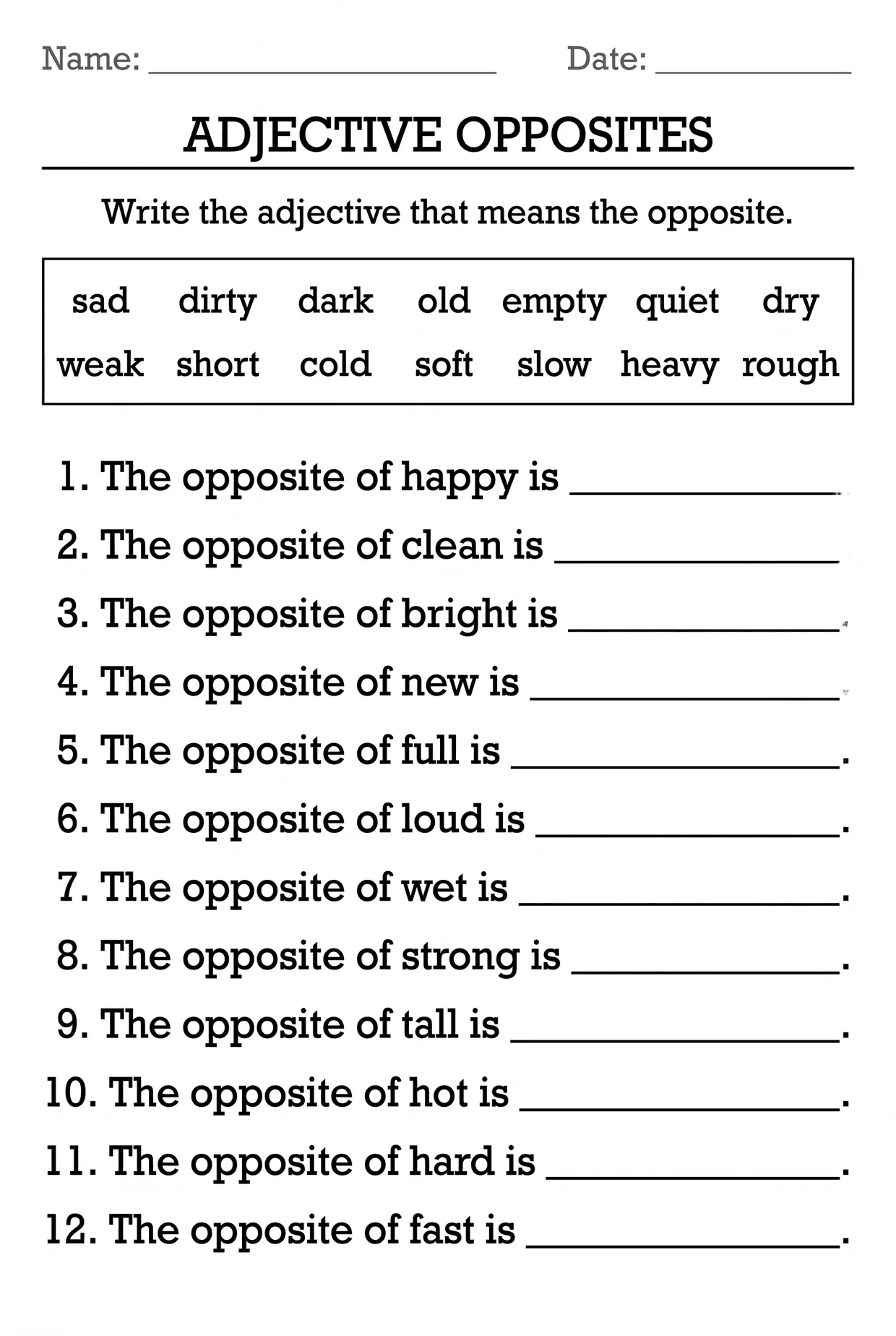
  10. Adjective Opposites Worksheet: Write the Opposite
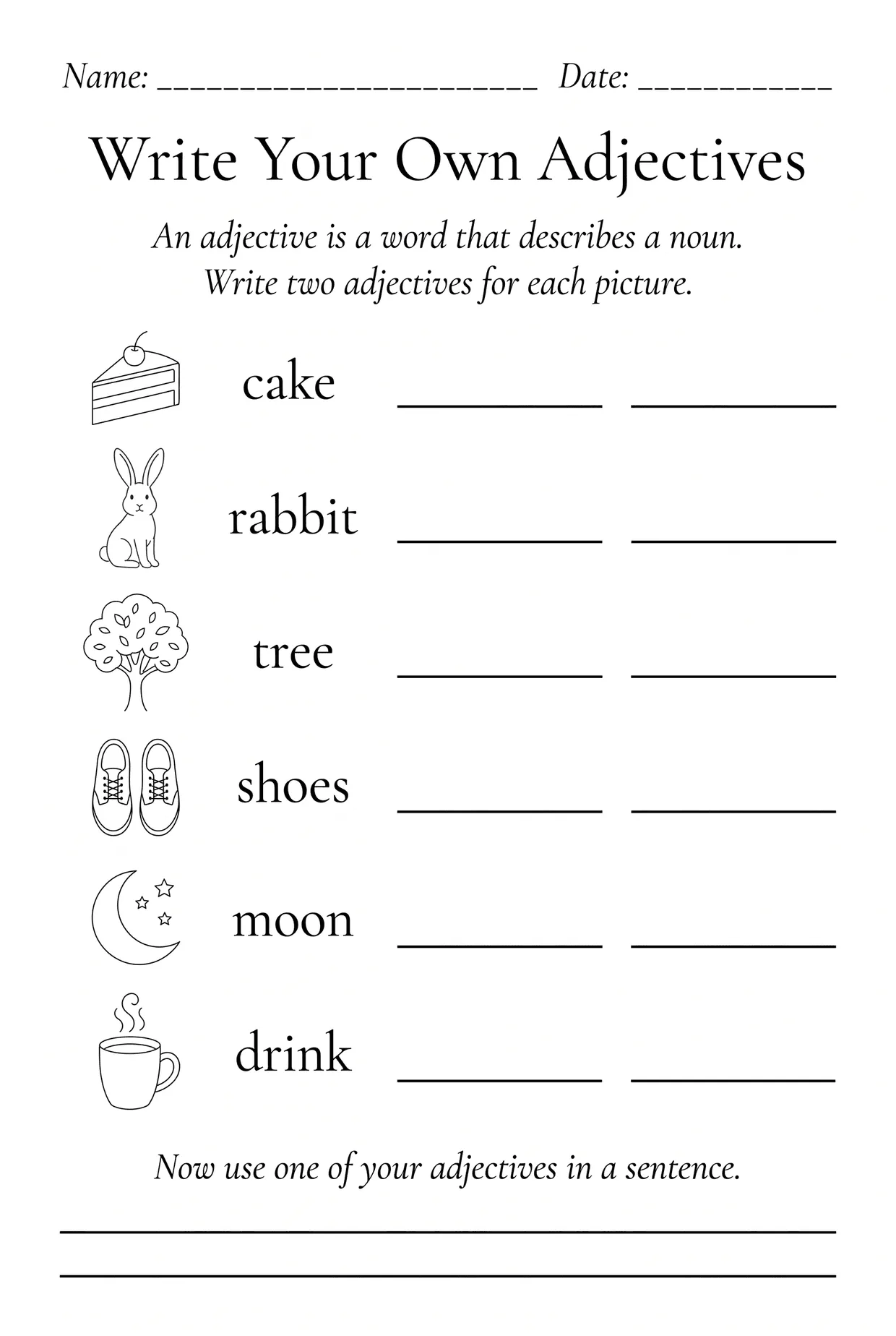
  11. Write Your Own Adjectives Worksheet for First Grade
Adjectives are taught as a definition, a word that describes a noun, and the definition holds up for about a week. It works fine on the fluffy cat. It starts wobbling the moment a child meets the cat is fluffy, where the describing word has moved to the far end of the sentence and stopped sitting politely in front of the thing it describes.

That is why this set spends its first three pages on pictures. A word next to a drawing of a teddy bear is not really a grammar exercise, it is a way of establishing that some words name things and other words say what those things are like, using examples where the difference is impossible to miss. The grammar proper starts at 08, when the pictures go away and the adjective has to be found inside a sentence that also contains a noun and a verb doing their own jobs.

If you are printing for a classroom rather than one child, the natural breaks are after 03, after 05 and after 09. Those are the three points where the task changes rather than just getting harder. And if you only print one page, print 11: it is the only one that asks a child to produce an adjective instead of recognizing somebody else’s.

01

Adjectives Tracing Worksheet: Trace, Write, Color

Meeting the words · 20 minutes
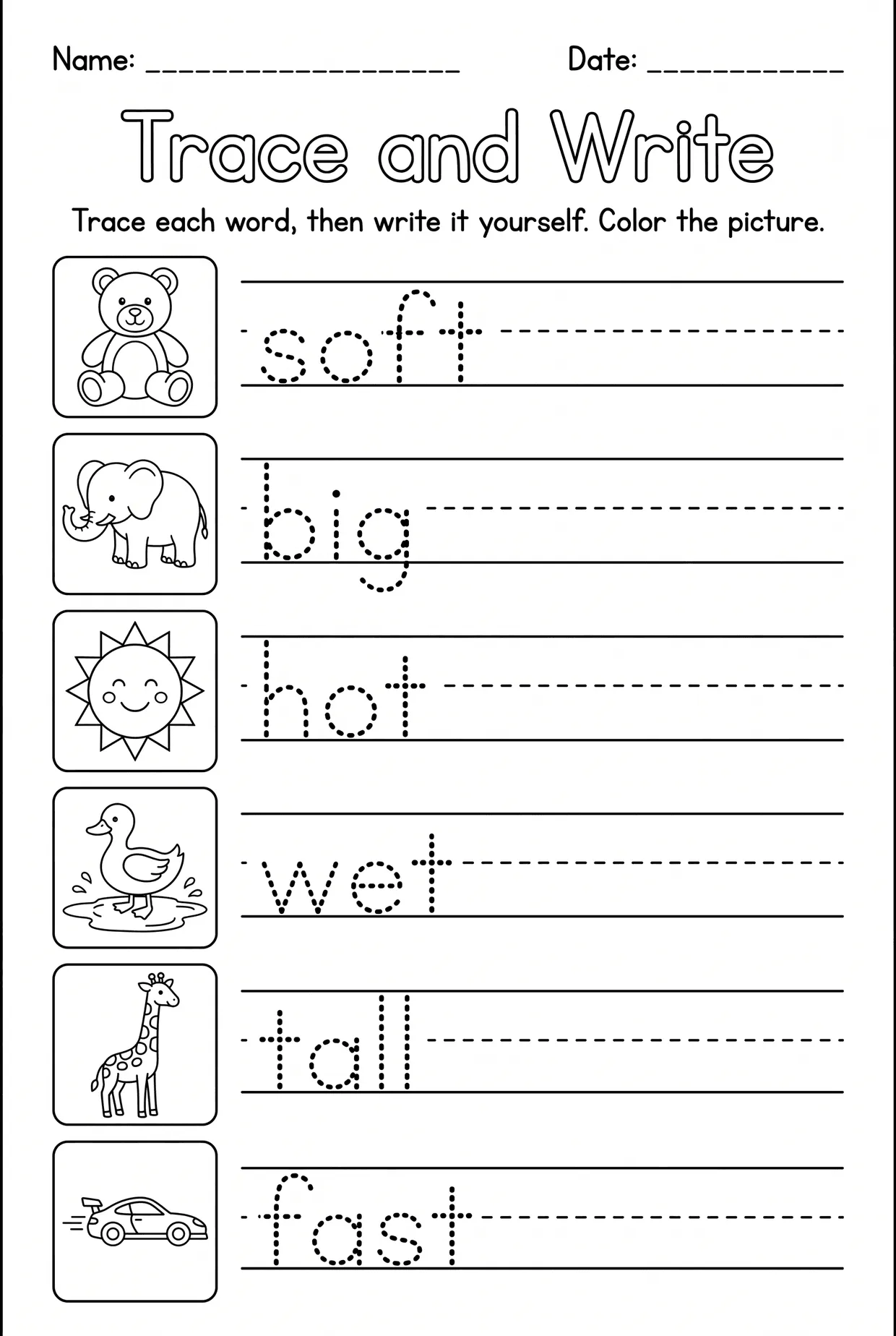
Adjectives Tracing Worksheet: Trace, Write, Color worksheet preview

Six describing words on guided handwriting lines, each beside a picture that shows it. Soft and a teddy bear, big and an elephant, hot and a smiling sun, wet and a duck in a puddle, tall and a giraffe, fast and a race car.

Why it starts here There is nothing to work out. The word and the picture agree, so a child meets the meaning and the spelling at the same time and the only demand is on the pencil. Start here if adjectives are genuinely new, and keep it as the warm-up on a morning when nobody wants to think.
02

Match the Adjectives Worksheet: Picture to Word

Meeting the words · 10 minutes
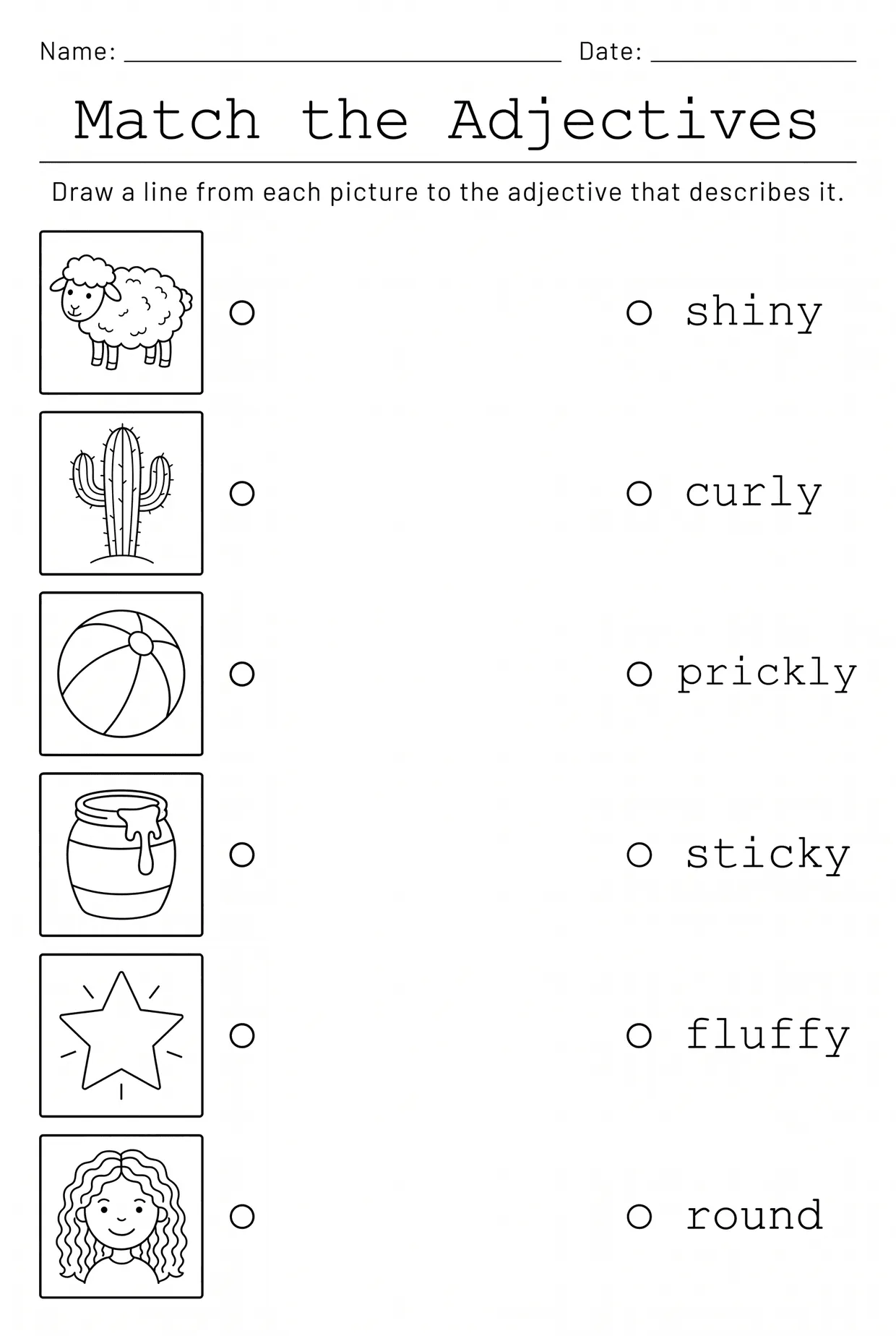
Match the Adjectives Worksheet: Picture to Word worksheet preview

Six pictures joined by a pencil line to the word that fits: a woolly sheep, a cactus, a beach ball, a dripping honey jar, a star and a girl with long curls. Fluffy, prickly, round, sticky, shiny and curly.

Why no colors Every word here is a texture or a shape. Color words are the on-ramp children take by themselves, so a page with no colors at all pushes straight into the vocabulary that usually gets skipped. It is also the quickest sheet in the set, which makes it a good warm-up before a writing page.
03

Adjectives Worksheet: Colors and Patterns in Pictures

Meeting the words · 15 minutes
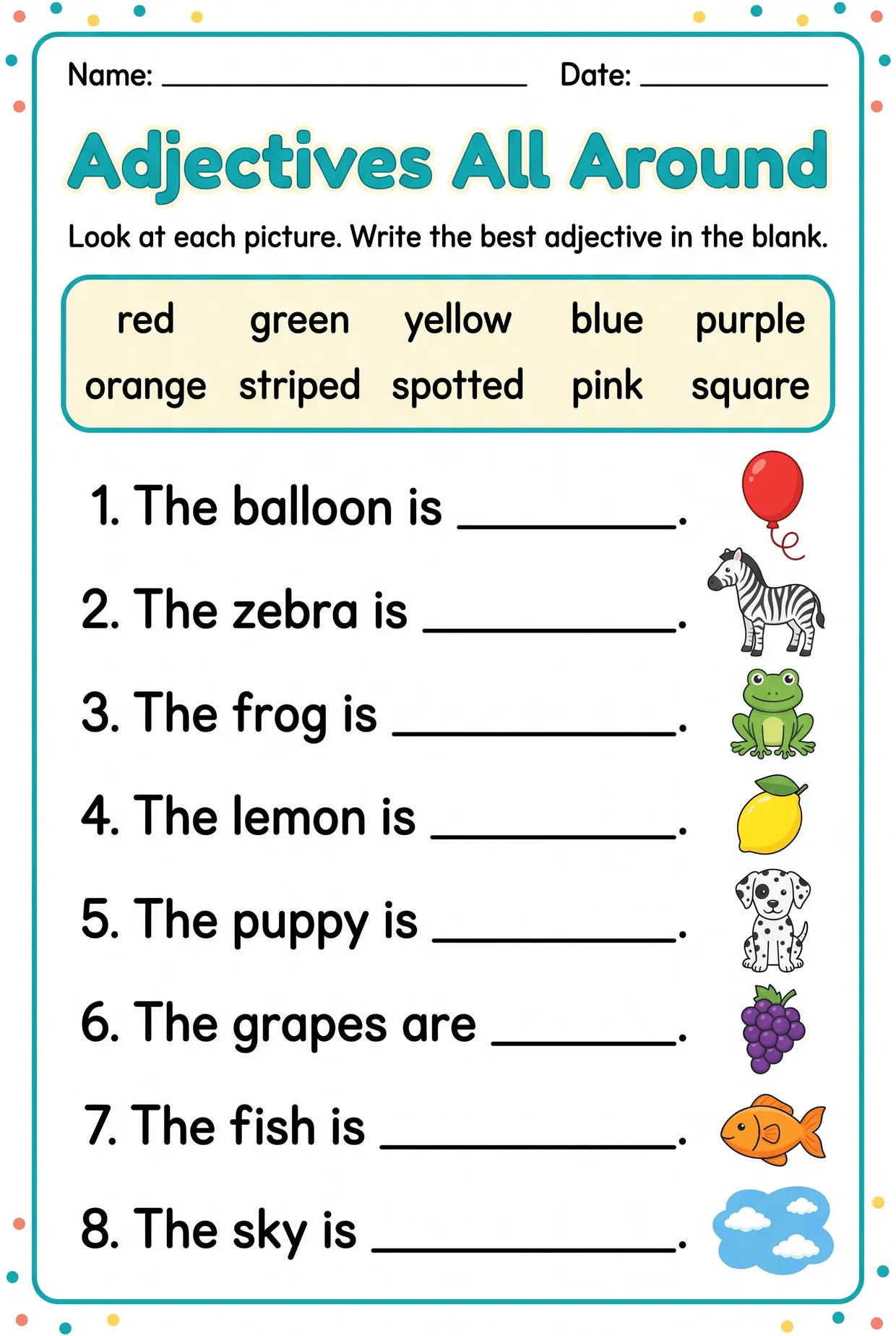
Adjectives Worksheet: Colors and Patterns in Pictures worksheet preview

Eight sentences with a bright picture beside each: a red balloon, a striped zebra, a green frog, a yellow lemon, a spotted puppy, purple grapes, an orange fish and a blue sky. Ten words in the bank.

Watch the zebra line The bank mixes colors with patterns, so striped and spotted sit alongside red and blue. A child who has only ever been asked for colors will reach for one on the zebra line and have to stop when none of them work. That pause is the whole lesson.
04

Sort the Adjectives Worksheet: Size, Feeling, Texture

Sorting by kind · 20 minutes
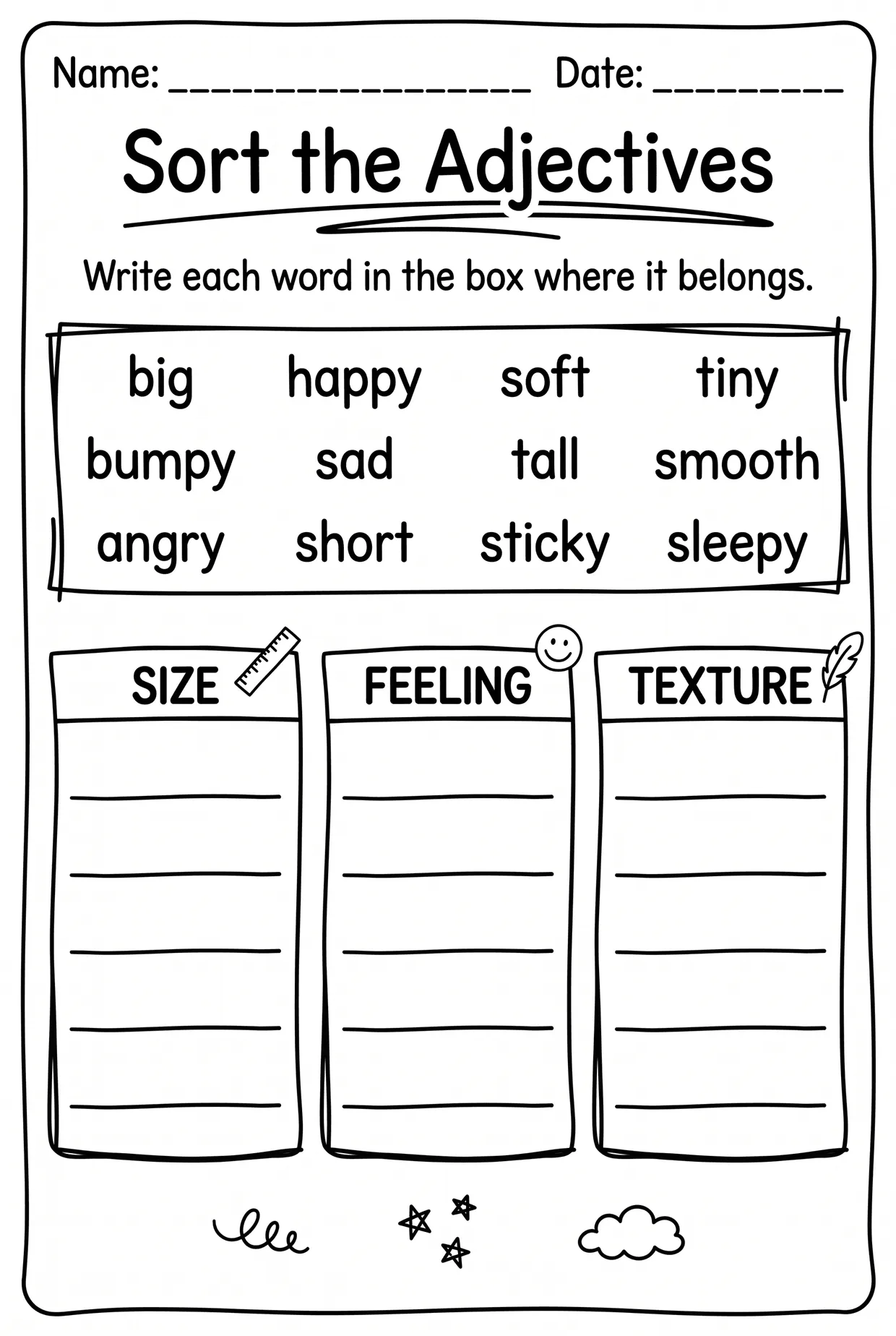
Sort the Adjectives Worksheet: Size, Feeling, Texture worksheet preview

Twelve words into three boxes headed Size, Feeling and Texture. Big, happy, soft, tiny, bumpy, sad, tall, smooth, angry, short, sticky and sleepy, four to a box.

The confusion worth having English uses feel for two different jobs, so soft is how a thing feels to a hand and sad is how a person feels inside. A first grader will reasonably try to put both in the same column. Point at the ruler, the smiley face and the feather on the headers before they start, not after.
05

Five Senses Adjectives Worksheet: Looks, Feels, Sounds

Sorting by kind · 15 minutes
Five Senses Adjectives Worksheet: Looks, Feels, Sounds worksheet preview

Nine adjectives into columns marked with an eye, a hand and an ear. Shiny, colorful and spotted are seen; bumpy, fuzzy and smooth are felt; loud, quiet and buzzing are heard.

Good for working alone The columns come out even at three words each, so a child who has placed six can reason out the last three without help. It also makes a point no fill-in-the-blank page can: describing words are the record of what a body noticed.
06

Adjectives Worksheet: Fill In the Describing Word

Into sentences · 15 minutes
Adjectives Worksheet: Fill In the Describing Word worksheet preview

Eight sentences waiting on a describing word. The giraffe, my kitten, the soup, the drum, the ant, the ice cube, the puddle and the race car, with ten words in the bank and two left over.

More than one right answer The puddle can be wet or cold, the kitten soft or happy, the soup hot or sticky. That is deliberate, and asking a child why they chose soft over happy gets at what an adjective actually does. Mark it on the reasoning, not the word.
07

Ocean Adjectives Worksheet: Describe the Sea

Into sentences · 15 minutes
Ocean Adjectives Worksheet: Describe the Sea worksheet preview

The seal, the beach, the whale, the sea turtle, the clownfish, a shark's tooth, the ocean and the seahorse, with a jellyfish and seaweed drawn around the page and ten adjectives in the bank.

Two sentences carry a clue The whale is the biggest animal, so it is huge, and the sea turtle swims slowly, so it is slow. Those sit third and fourth on purpose, so a child who is stalling gets a worked example partway down instead of eight identical prompts.
08

Find the Adjective Worksheet: Circle and Write It

Finding them · 15 minutes
Find the Adjective Worksheet: Circle and Write It worksheet preview

Eight sentences with exactly one adjective in each. The fluffy cat, a red kite, the tiny bug, a sweet cake, a huge whale, the wet dog, shiny shoes and the loud bell. Circle it, then write it on the line.

Why circle and write both Circling alone lets a child guess and move on. Copying the word out forces a second look and leaves a written record you can check at a glance. Every sentence also holds a noun and a verb, so the adjective has to be found among real competition.
09

Pick the Adjective Worksheet: Circle the Right Word

Finding them · 15 minutes
Pick the Adjective Worksheet: Circle the Right Word worksheet preview

Ten sentences offering two words, one an adjective and one not. Sleepy or jumped for the owl, table or cold for the wind, sweet or ran for the plum, tall or bicycle for the tree, on through muddy boots and a warm cup of milk.

The trick that stops working The wrong answers alternate between verbs and nouns rather than being all one kind, so nobody can settle into the answer is never an action word. Teach reading the whole sentence back with the chosen word in place; that habit carries into every grammar sheet after this one.
10

Adjective Opposites Worksheet: Write the Opposite

Stretching the vocabulary · 15 minutes
Adjective Opposites Worksheet: Write the Opposite worksheet preview

Twelve prompts in the form the opposite of happy is blank, running through clean, bright, new, full, loud, wet, strong, tall, hot, hard and fast. Fourteen adjectives in the bank.

Two words too many With twelve blanks and fourteen choices, nobody coasts to the end and fills the last line with whatever is left. Heavy and rough are both plausible leftovers, so every line has to be answered on meaning. It is a small decision that changes the last three questions completely.
11

Write Your Own Adjectives Worksheet for First Grade

Writing your own · 20 minutes
Write Your Own Adjectives Worksheet for First Grade worksheet preview

Six nouns with a small picture beside each, cake, rabbit, tree, shoes, moon and drink, and two blank lines apiece. No word bank anywhere on the page, then one sentence to write at the bottom.

Why it finishes the set Asking for two words rather than one is what does the work. The first is usually a color or a size, and the second is where a child has to reach for something they have not used all week. A child who aced every circling page can still stall here, and that is the useful information.

One more thing.

If your kids finish a unit and you're not sure what to do next, my honest advice: don't move on yet. Spend a week mixing these in as warm-ups. Fluency isn't a unit, it's a habit, and the sheet that builds it is usually the one they ask to do again.

Browse more reading worksheets → More roundups