Kindergarten addition is a smaller job than it sounds and a longer one than it looks. Every sum on this page stays within 10, which is the whole of the kindergarten standard, but getting there means three separate things: understanding that two amounts join into one, recalling small sums without counting them out, and reading an equation in whichever direction it happens to be written.
The seventeen free worksheets below take those in order. The first eight give the child a row of answers to choose from, which is a real support, since recognizing the right sum is much easier than producing it. The next five take the choices away and leave a box. The last four stack the numbers vertically, which is how addition will be written for the rest of school and which throws more children than anyone expects.
Every one is a printable PDF with no account, no watermark and no email. Start where your child already is rather than at number one, and treat the sheets within each stage as interchangeable, since they cover the same ground with different numbers and different pictures.
Ticket to Ten: Kindergarten Addition Worksheet
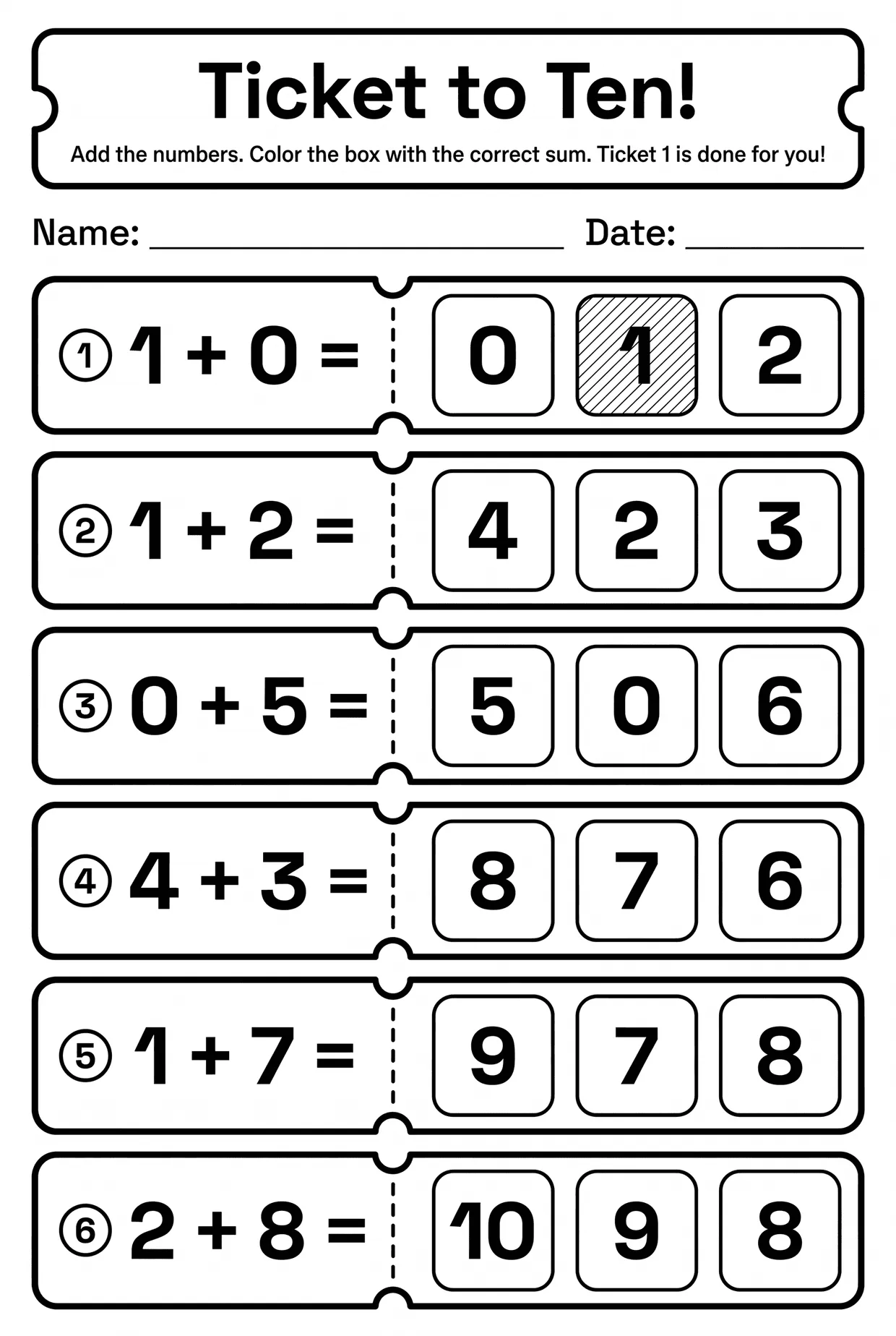
Six problems drawn as cinema tickets, the problem on the stub and three answers on the body. Six on a full page means everything is enormous, which is exactly right for a child who is still working out which way round to read an equation. It opens at 1 + 0 and finishes at 2 + 8.
Super Sums: Kindergarten Addition Worksheet (B&W)
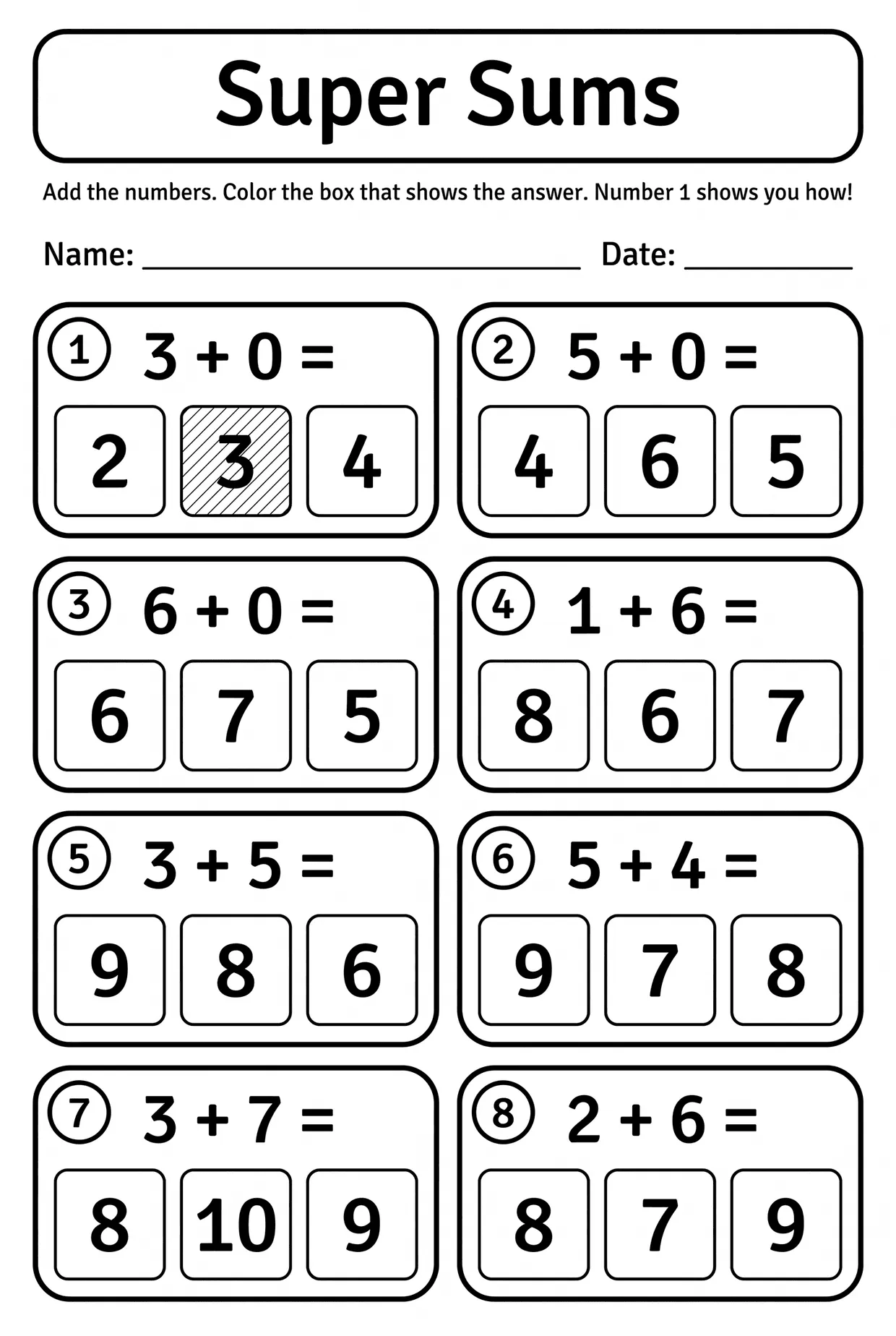
Eight panels, three answers each, and the first three problems all add zero: 3 + 0, then 5 + 0, then 6 + 0. After that it moves along to 1 + 6, 3 + 5, 5 + 4, 3 + 7 and 2 + 6.
Add and Color Cards: Kindergarten Addition Worksheet
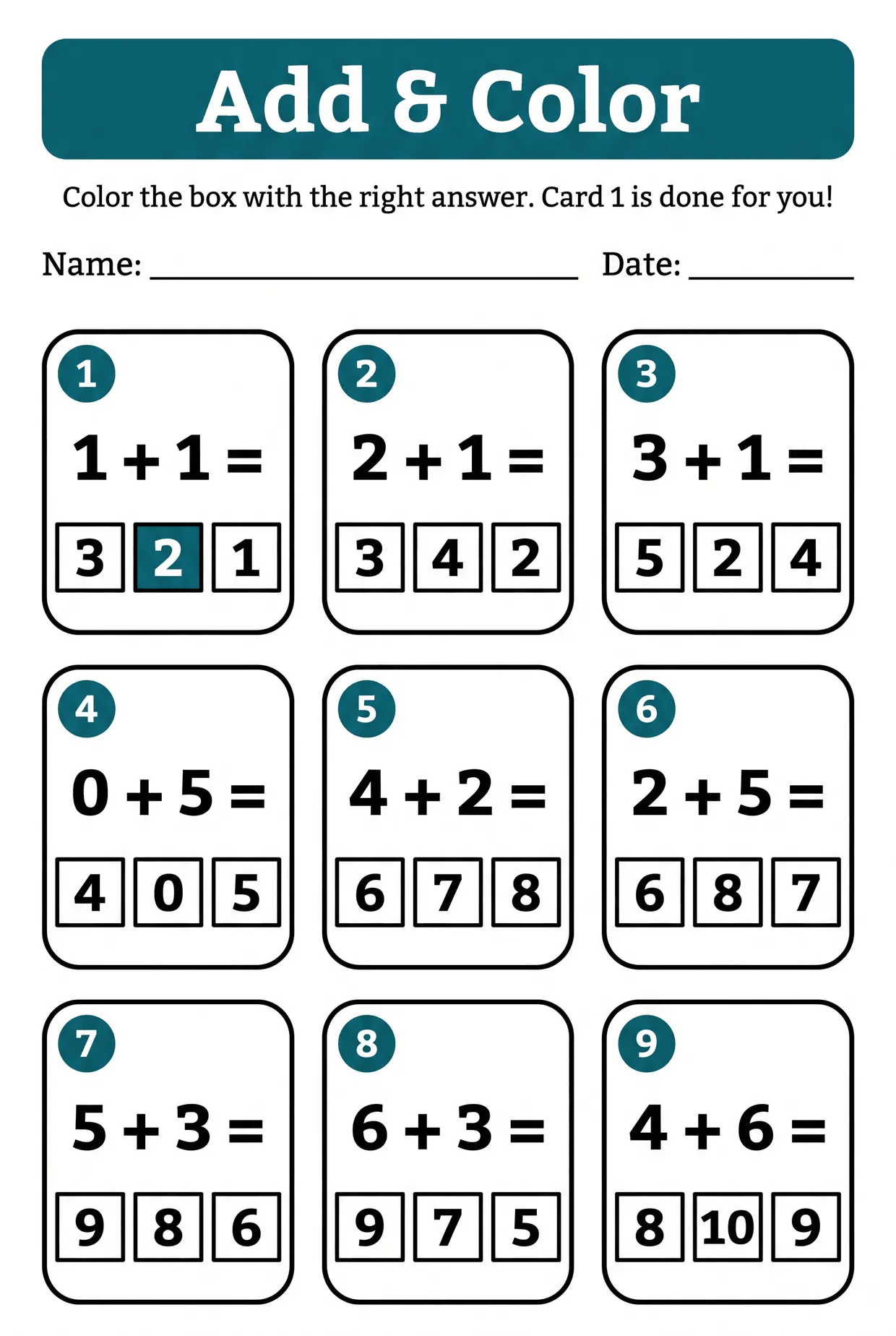
Nine numbered cards under a teal banner, three answers apiece. The sums climb in strict order, 2 at the top left through to 10 at the bottom right, so the easy ones come first and the harder ones arrive with some momentum behind them.
Find the Sum: Kindergarten Addition Worksheet
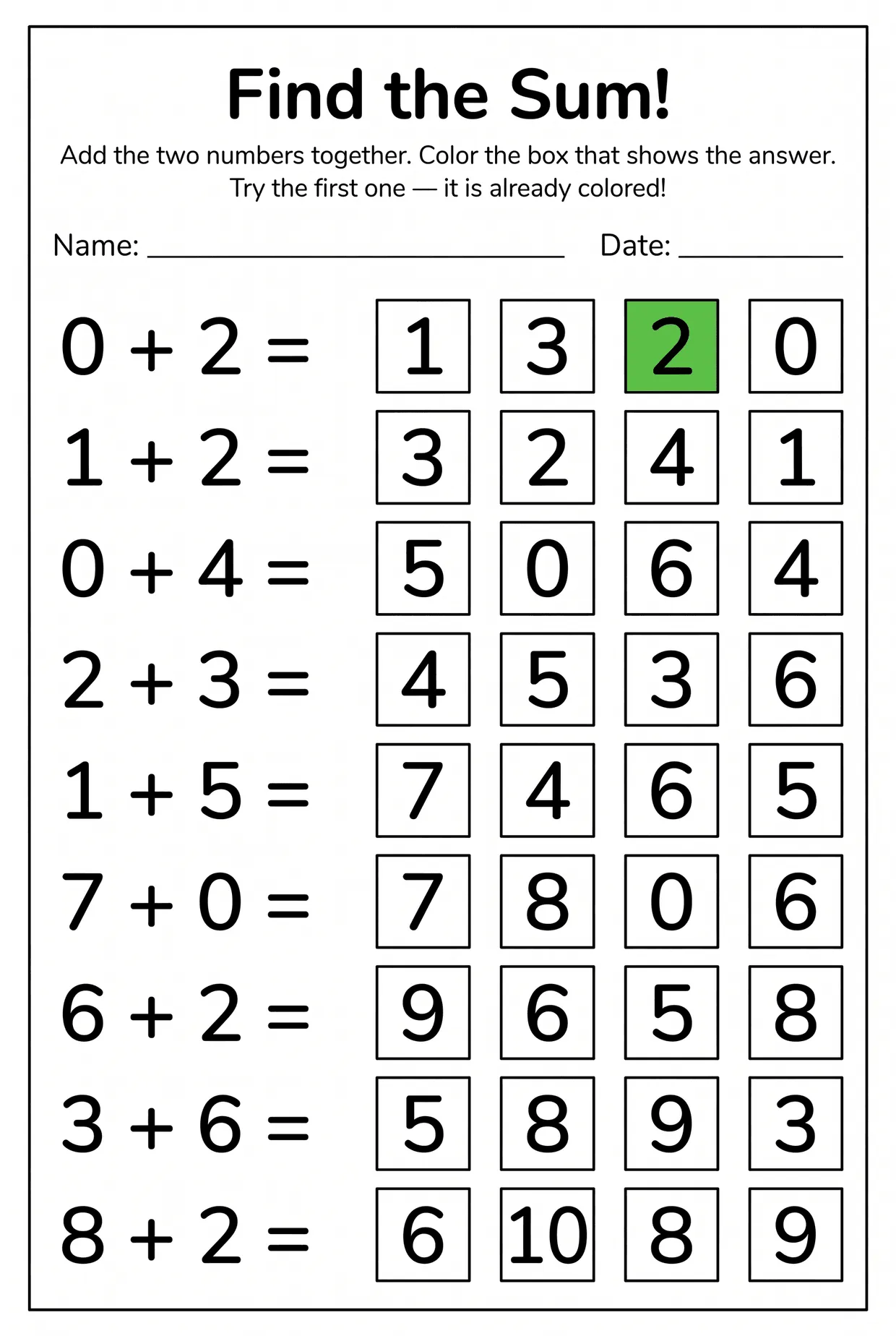
Nine problems, four answer boxes each, and a green box colored on the top row as the example. The answers again land in order, 2, 3, 4 and on up to 10, which quietly turns the page into a number line.
Color the Sum: Kindergarten Addition Worksheet
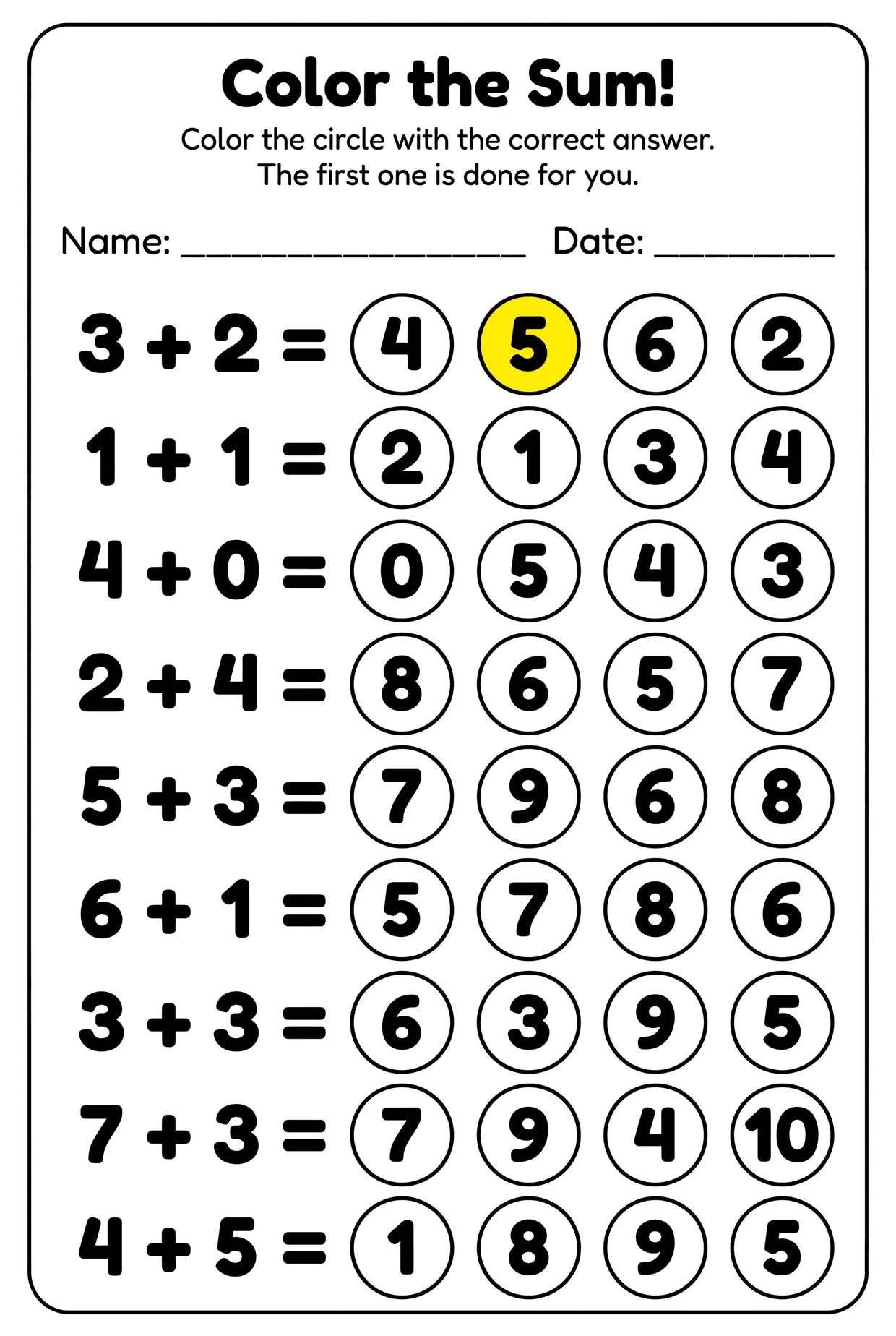
Nine problems in a rounded, friendly typeface with four circles to choose between and a yellow example at the top. Doubles turn up three times here, 1 + 1 and 3 + 3 and the near-double 4 + 5.
Sum It Up: Kindergarten Addition Worksheet to 10
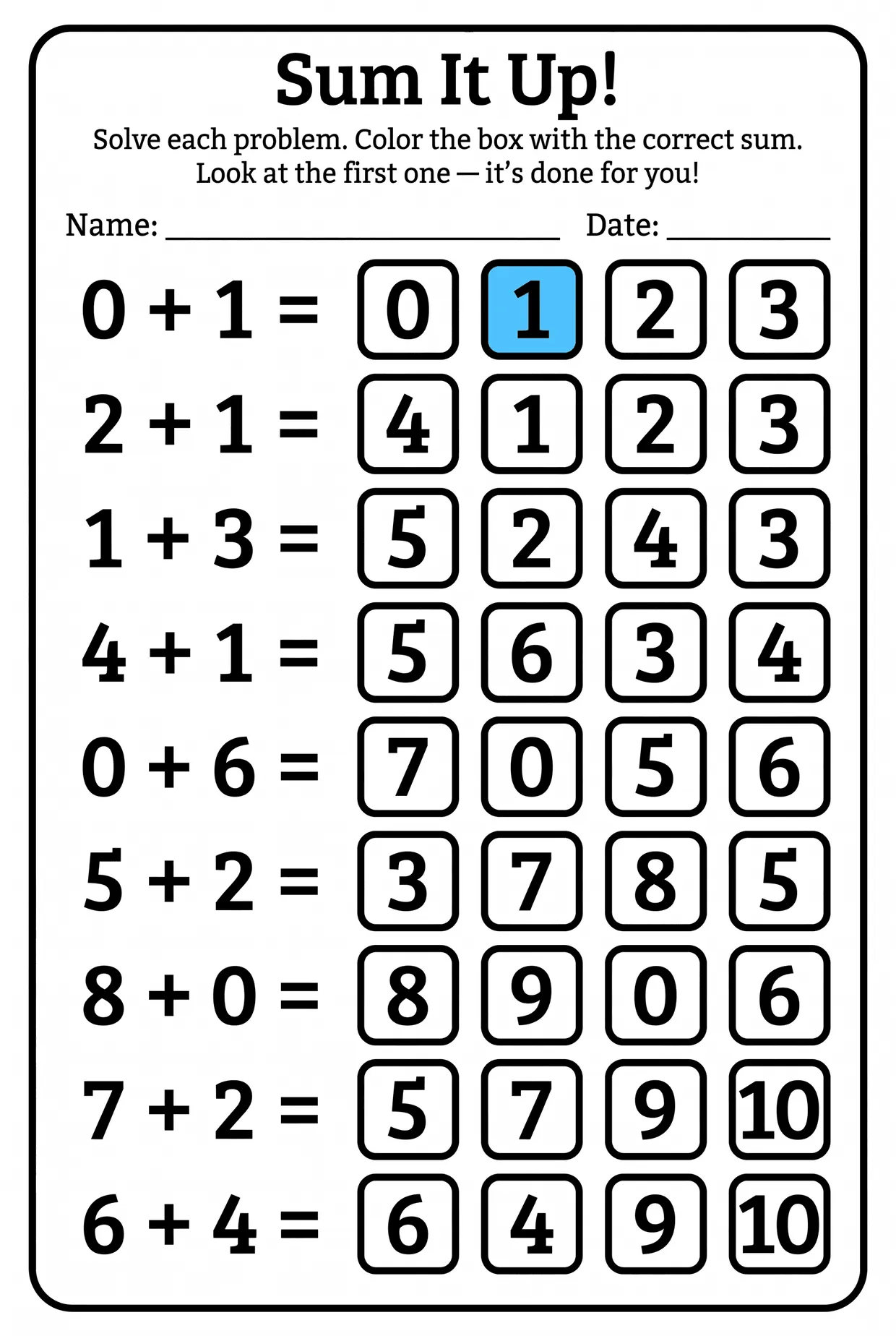
Nine problems with four boxes each and a blue example already filled in. Three of the nine add zero, 0 + 1 and 0 + 6 and 8 + 0, and 10 appears as an answer choice twice so the number itself stops looking unfamiliar.
Add and Color: Kindergarten Addition Worksheet
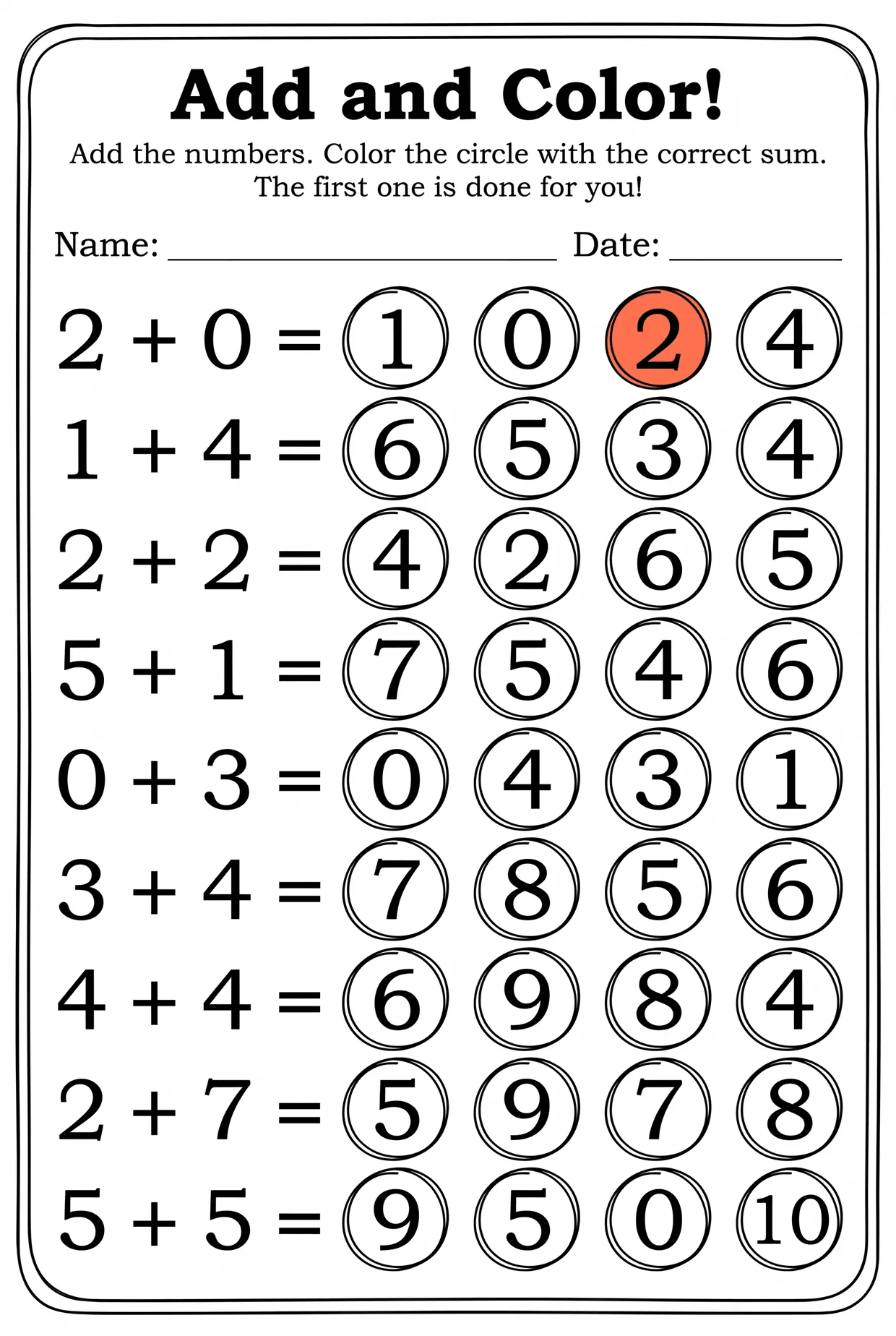
Nine problems, four circles apiece, set in a crisp serif with an orange example at the top. It opens at 2 + 0 and 1 + 4 and finishes at 2 + 7 and 5 + 5, so it covers the whole range in one page.
Color the Answer: Kindergarten Addition Worksheet
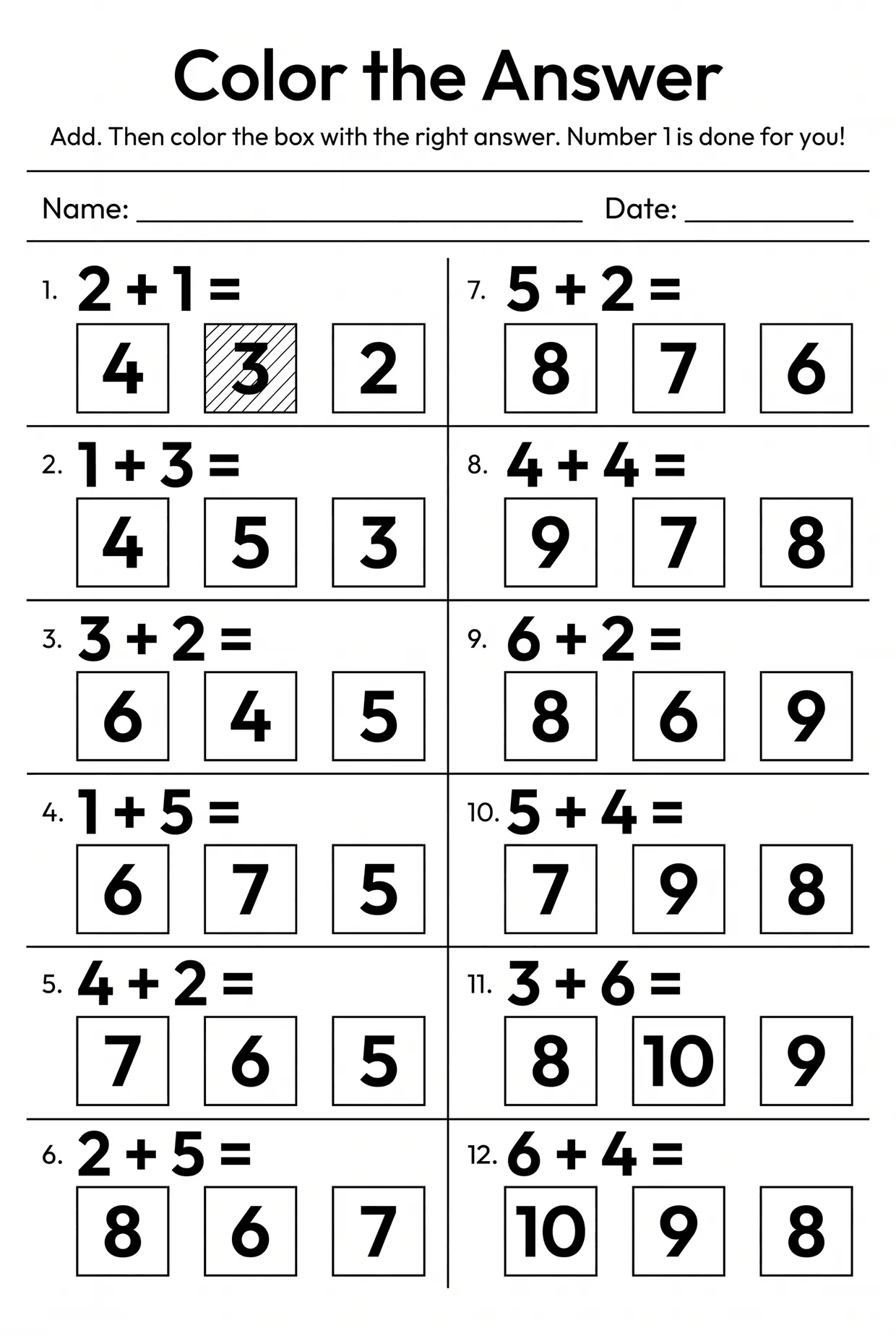
Twelve problems, six to a side, three answers under each. This is the longest of the choose-the-answer pages and the last one before the choices disappear entirely.
Adding Up to 10: Kindergarten Addition Worksheet
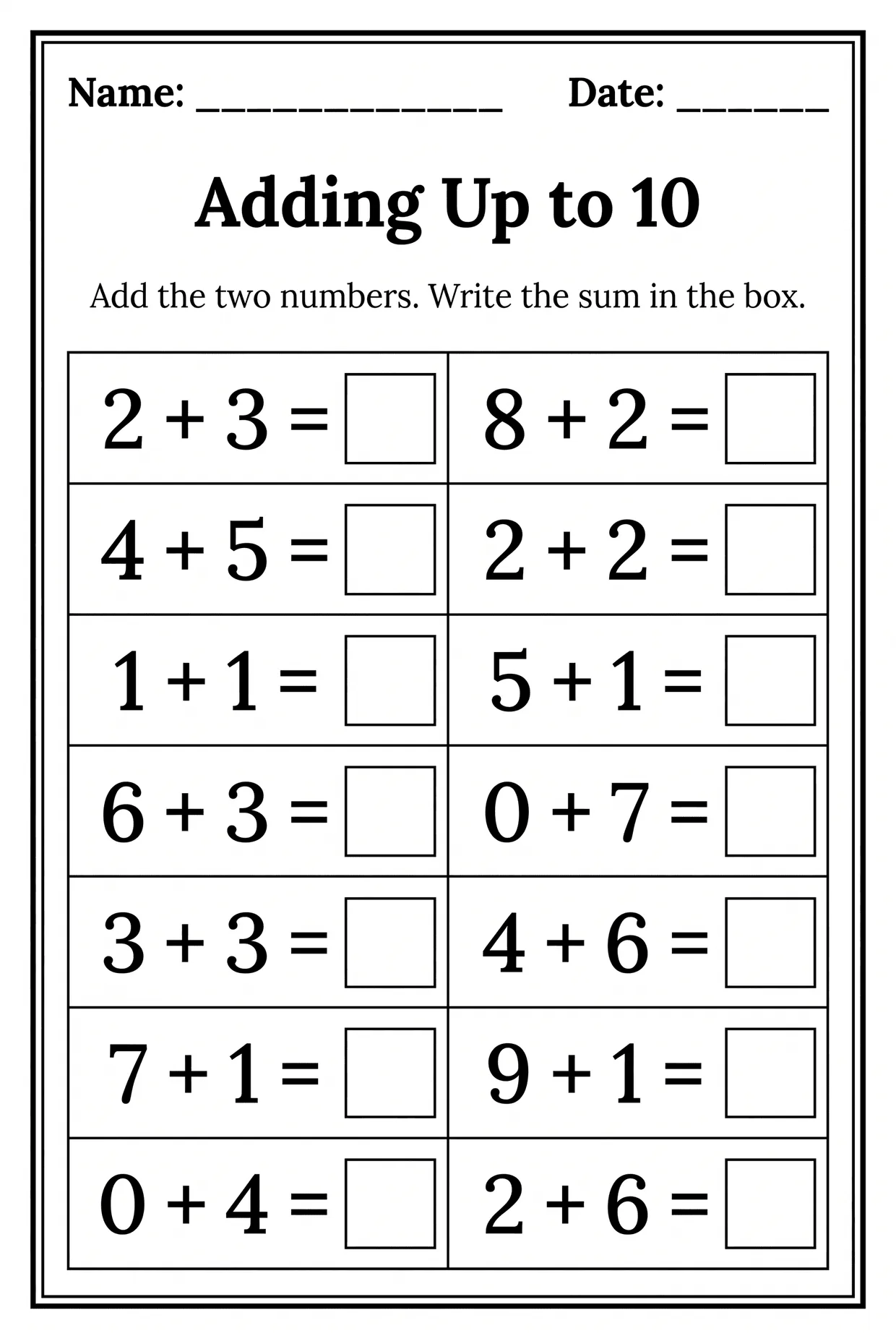
Fourteen problems in two columns, one box per answer, and nothing else on the page. No choices any more: the child works out the sum and writes it.
Add It Up: Kindergarten Addition Worksheet Sums to 10
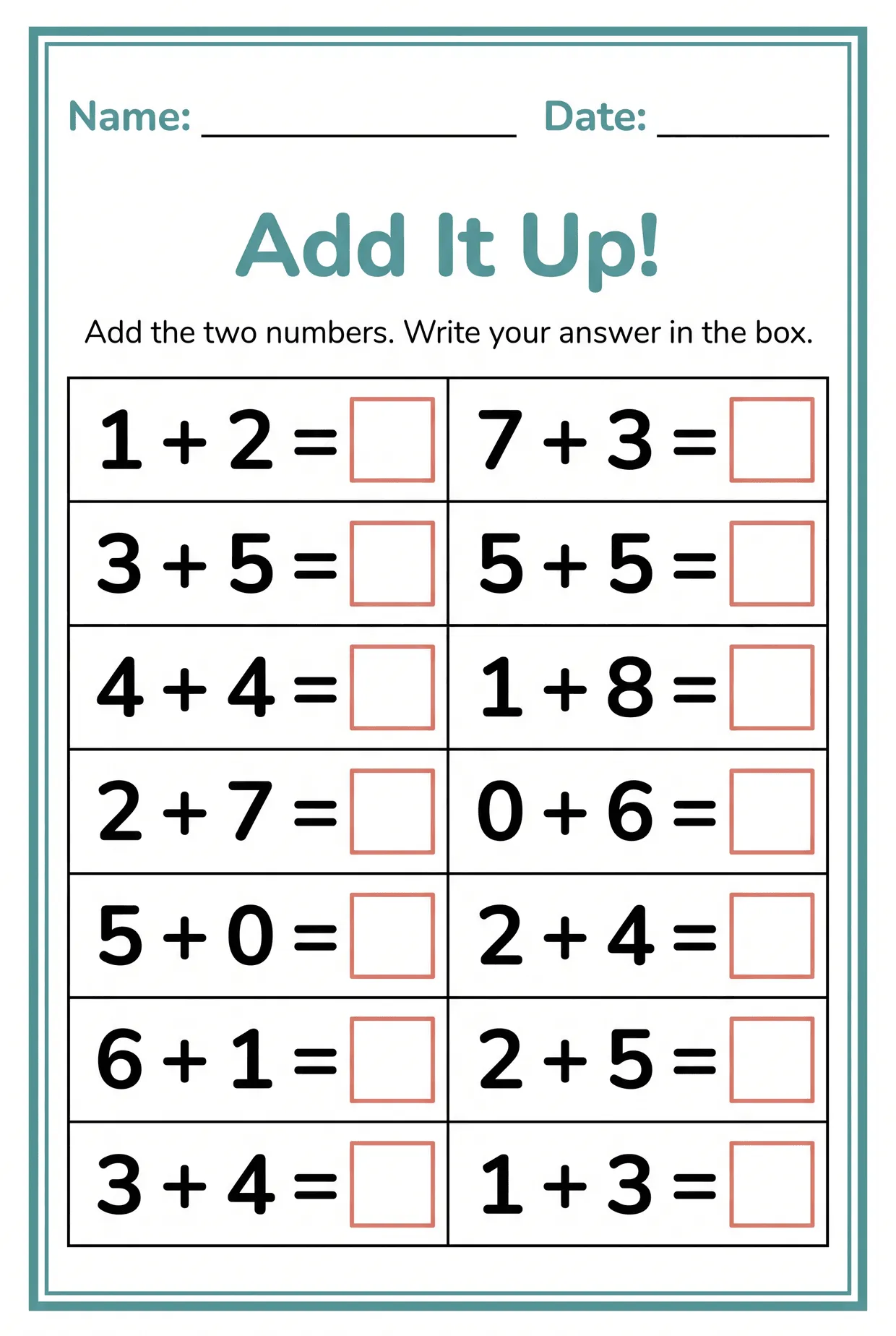
The same fourteen-problem shape with coral answer boxes inside a teal border. Doubles at 4 + 4 and 5 + 5, zero at 5 + 0 and 0 + 6, and pairs like 2 + 7 and 1 + 8 where counting on from the larger number is much faster.
Bee Themed Kindergarten Addition Worksheet
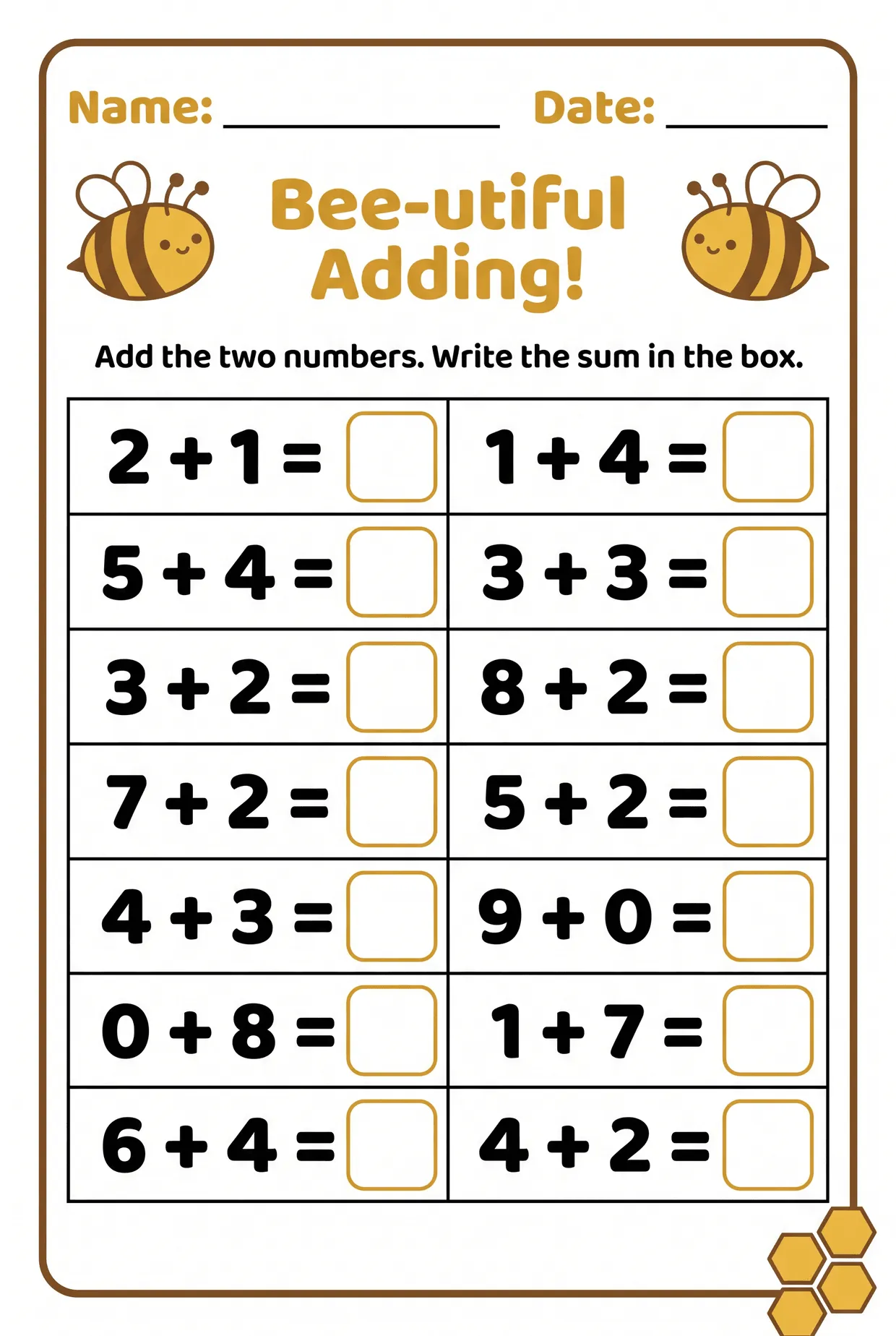
Two smiling bees over the title, a honeycomb in the corner, and fourteen problems underneath with a box for each sum. The pairs are shuffled rather than ordered, so there is no pattern to coast on.
Dinosaur Themed Kindergarten Addition Worksheet
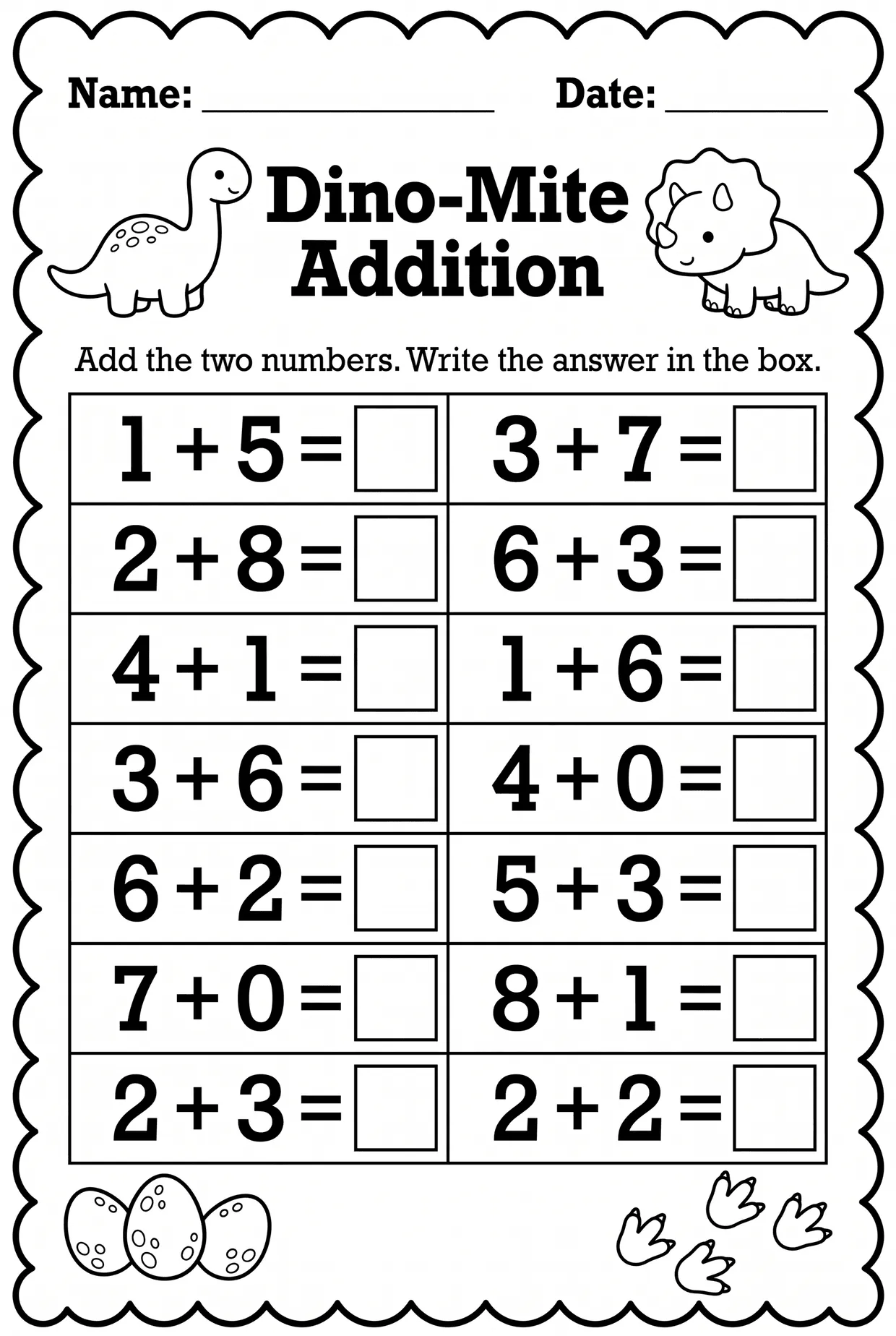
A long-necked dinosaur and a triceratops flank the title, with eggs and footprints along the bottom, all drawn in outline. Fourteen problems run from 2 + 2 and 4 + 1 up to 2 + 8 and 3 + 7.
Owl and Woodland Kindergarten Addition Worksheet
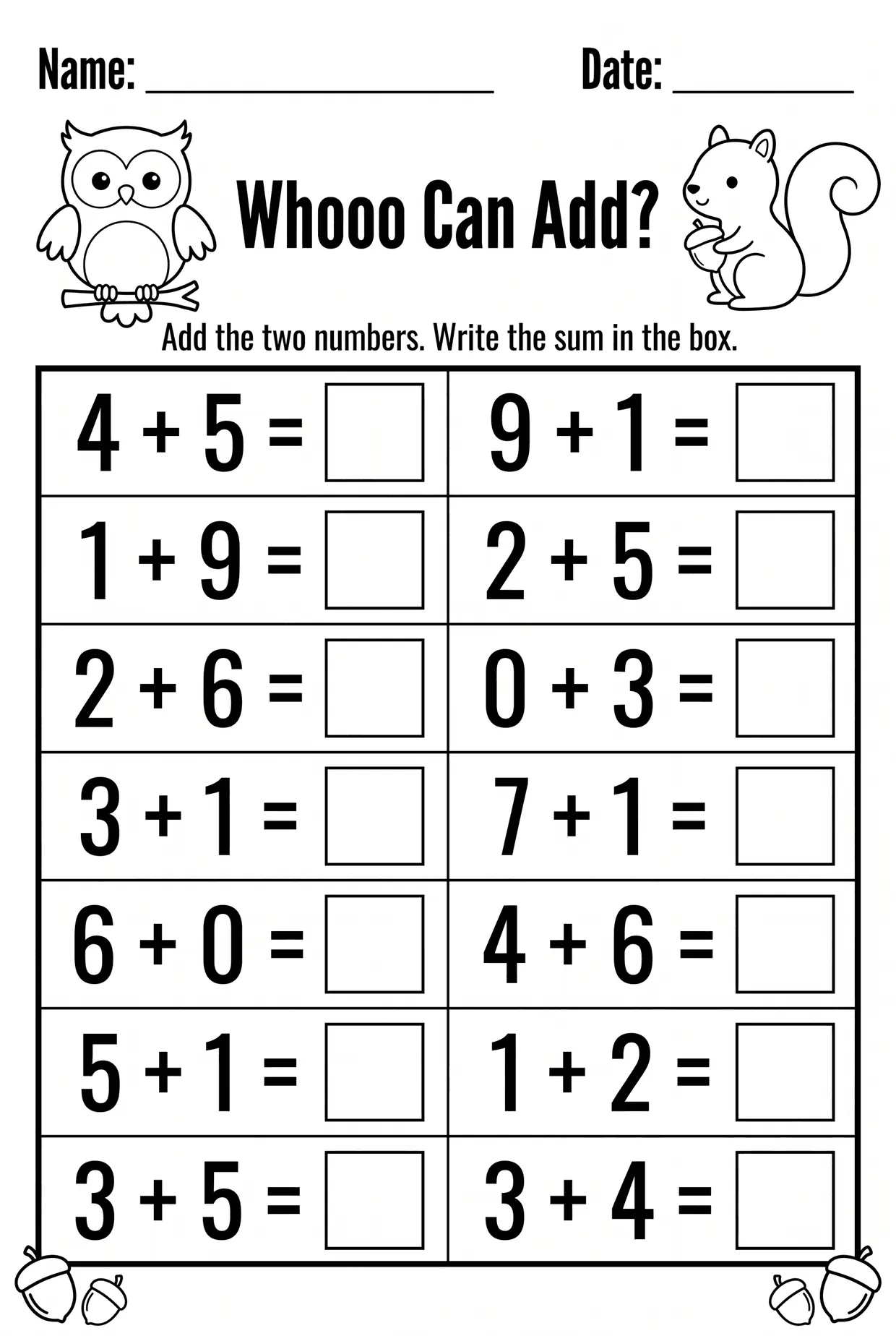
An owl on a branch and a squirrel with an acorn, over fourteen problems with a box each. 4 + 5 opens the page and 1 + 9 comes straight after, so a child cannot settle into a rhythm and stop reading.
Line Up and Add: Kindergarten Addition Worksheet
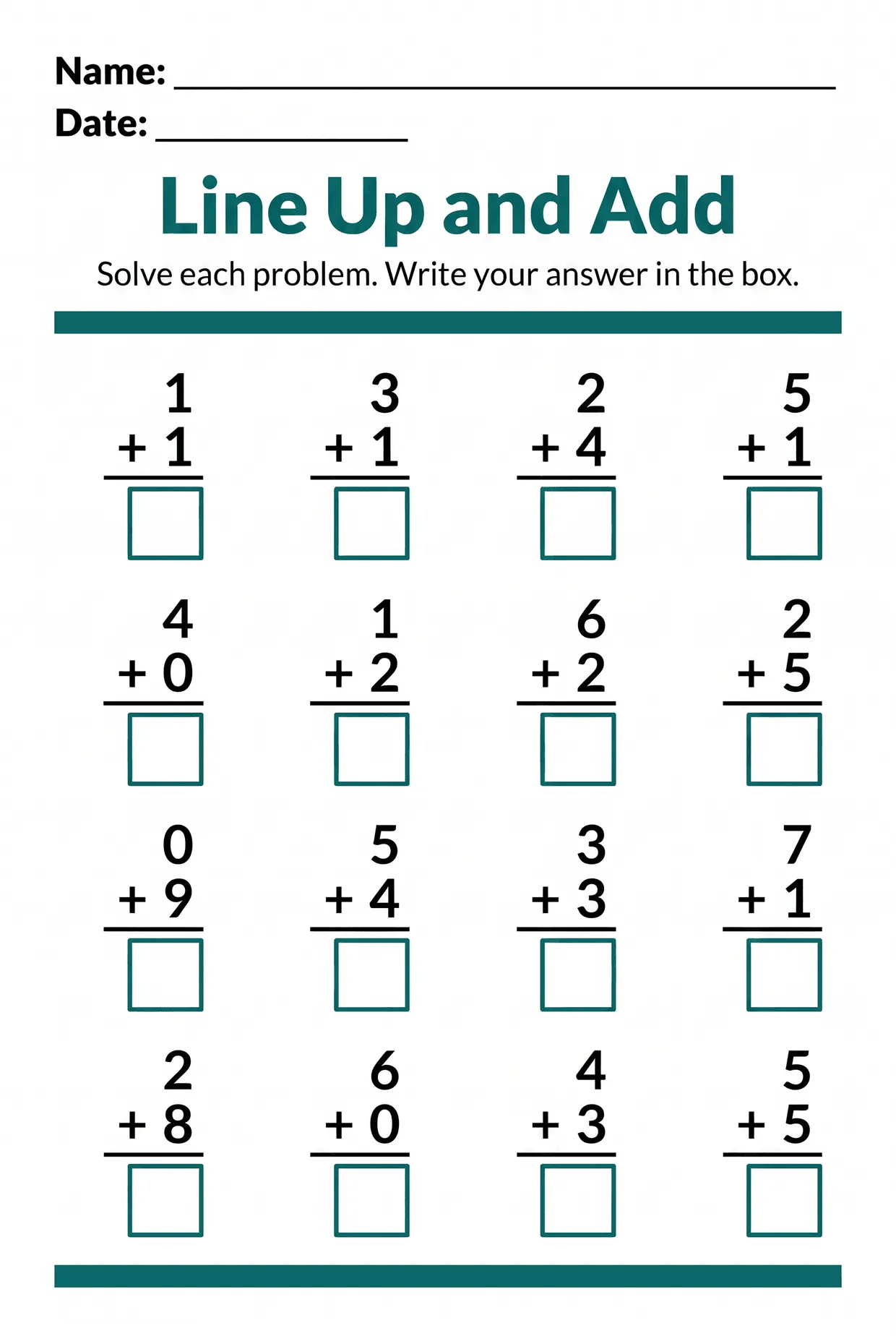
The first stacked page, and the gentlest. Sixteen problems in four rows of four, each with a box under the line, opening with 1 + 1 and 4 + 0.
Column Addition Worksheet for Kindergarten: 20 Sums
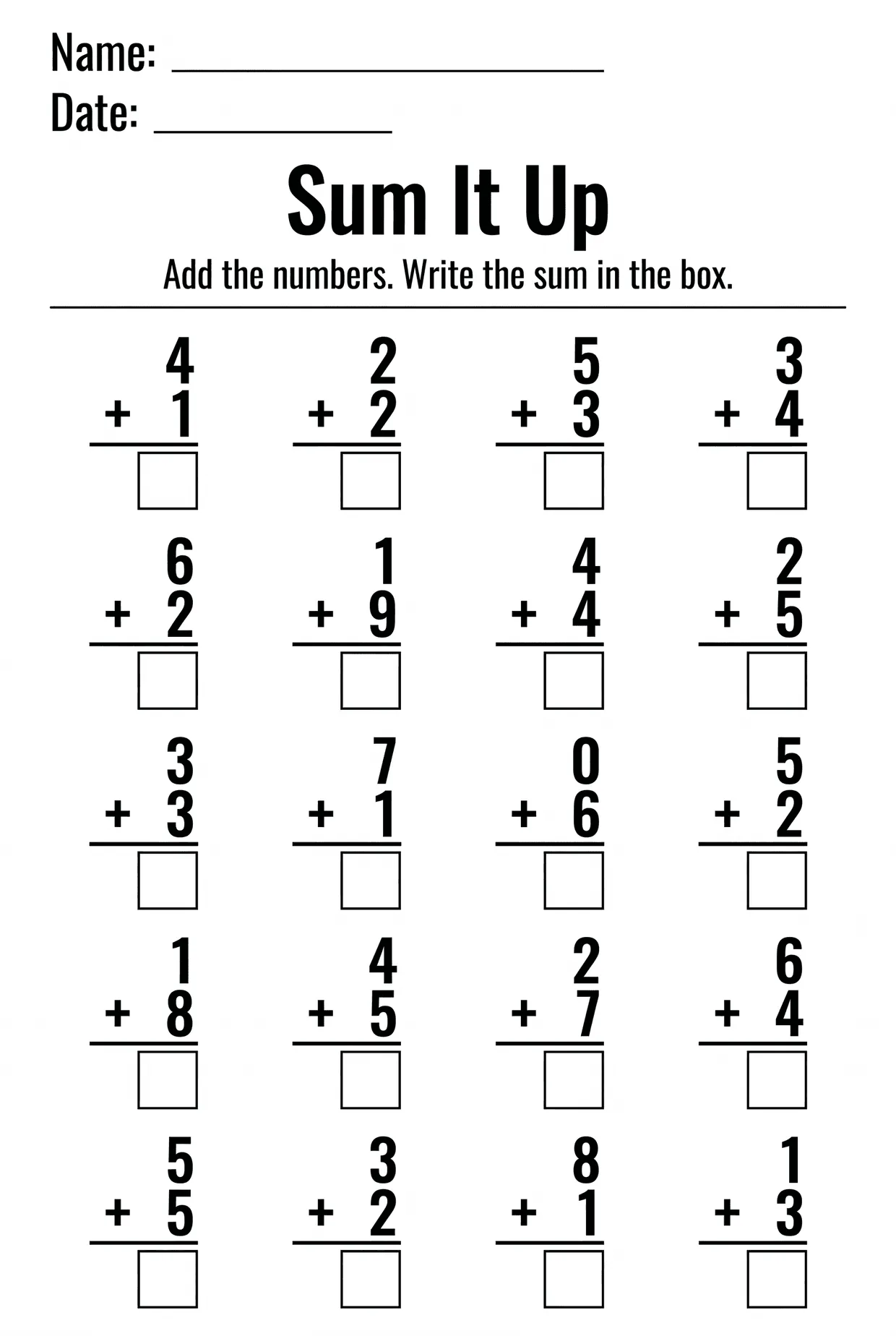
Twenty stacked problems in four columns, each with a printed box for the answer. Same idea as the page above with four more problems and no decoration at all.
Adding Down: Kindergarten Addition Worksheet to 10
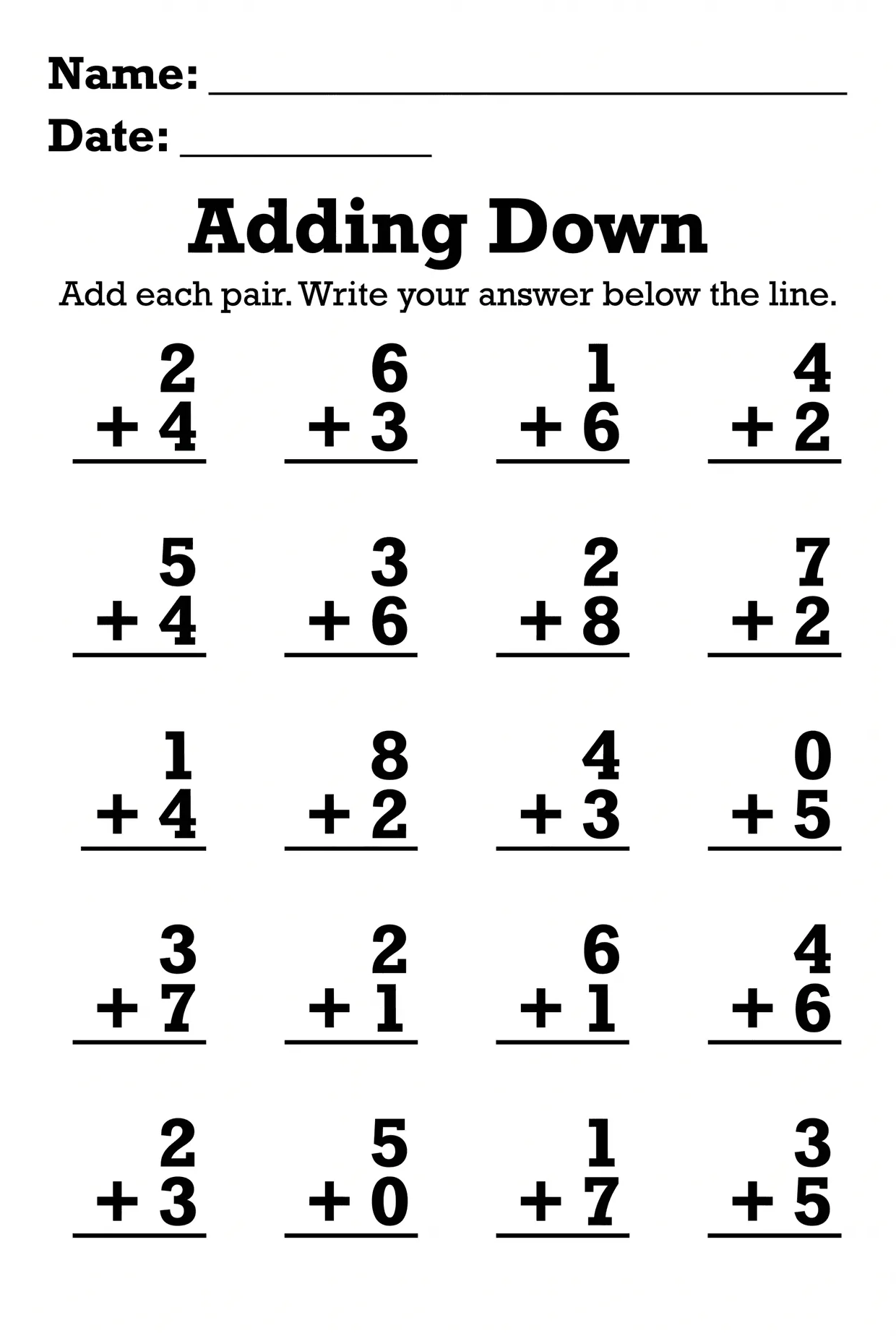
Twenty stacked problems with the answer box taken away, so there is just the line and open space beneath it. Both 8 + 2 and 2 + 8 appear, a quiet way of showing that the order of the two numbers does not change the total.
Stack and Add: Kindergarten Addition Worksheet
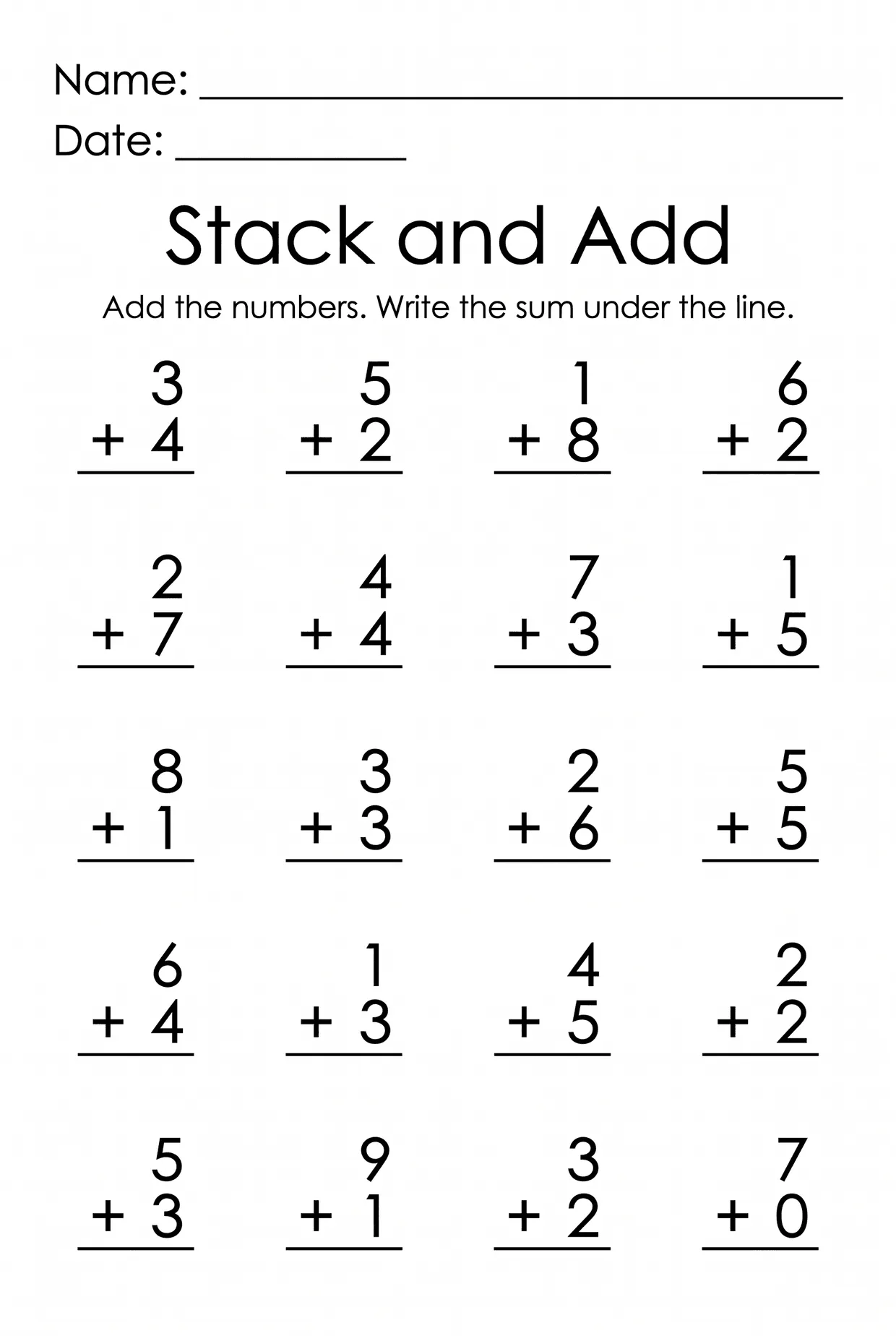
The last page, and the twin of the one before it: same open-line layout, same twenty problems' worth of work, an entirely different set of pairs. Sums reach ten four times and never go beyond.
One more thing.
If your kids finish a unit and you're not sure what to do next, my honest advice: don't move on yet. Spend a week mixing these in as warm-ups. Fluency isn't a unit, it's a habit, and the sheet that builds it is usually the one they ask to do again.